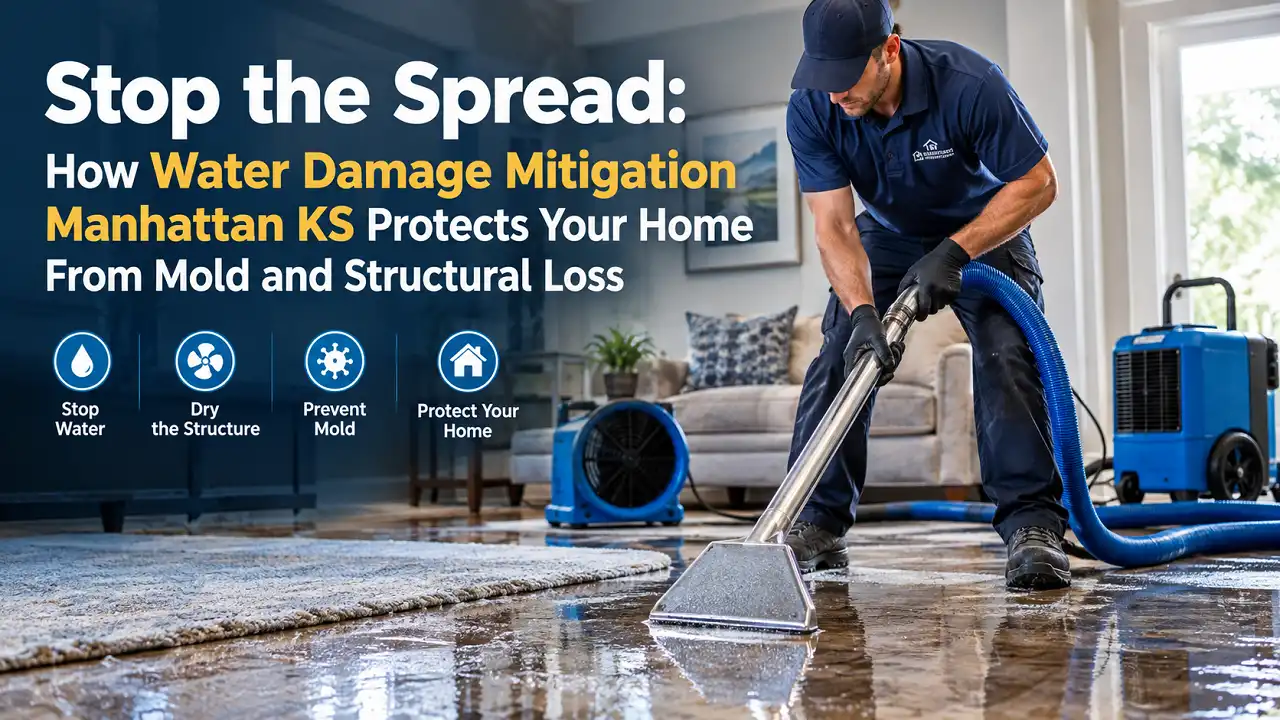
Stop the Spread: How Water Damage Mitigation Manhattan KS Protects Your Home From Mold and Structural Loss
Water does its worst damage in the first 48 hours. In that window it wicks into drywall, swells subfloors, and gives mold spores the moisture they need to grow. Fast, professional water damage mitigation Manhattan KS homeowners can rely on is what separates a three-day dry-out from a three-month rebuild. At Water Damage Restoration Topeka, we respond 24/7 across Riley County to stop the water, dry the structure, and protect your insurance claim. Every hour you wait adds cost.
Key Takeaways
- Dry within 24 to 48 hours. The EPA says drying wet materials in this window usually prevents mold growth.
- Know your water category. Clean supply-line water (Category 1) can turn into Category 2 or 3 if it sits. That change shifts both the cleanup protocol and your costs.
- Document before you discard. Photos, videos, and material samples protect your NFIP or homeowners claim. Most standard policies exclude mold damage.
Why Manhattan, KS Properties Face Unique Water Damage Risks
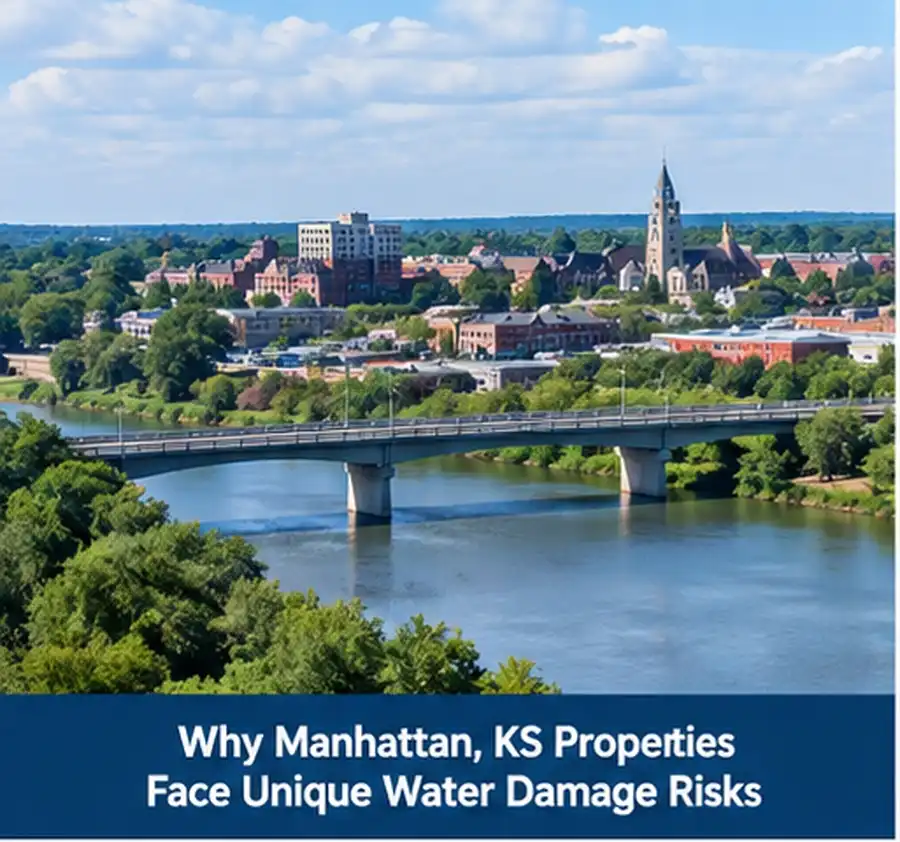
Manhattan sits where the Big Blue River meets the Kansas River, with Tuttle Creek Lake just upstream. Wildcat Creek has a long history of flash flooding during heavy spring storms. Add aging infrastructure in older neighborhoods, and you get a city that sees water losses all year.
On recent emergency service calls near Kansas State University, we found student rentals with slow supply-line leaks that had gone unreported for weeks. Our crews frequently find saturated foundation walls in older Downtown Manhattan basements after spring rains. These are the same freeze-thaw pipe failures we handle in historic Westboro basements back in Topeka. The climate is the same, and so are the risks.
| Risk Factor | Peak Season | Common Damage | Mitigation Priority |
|---|---|---|---|
| Flash flooding (Wildcat Creek, Blue River) | April to June | Basement flooding, Category 3 water | Extraction plus antimicrobial treatment |
| Frozen/burst pipes | December to February | Wall cavities, ceilings, subfloors | Shutoff, extraction, cavity drying |
| Summer humidity | July to August | Hidden mold, musty basements | Dehumidification, moisture mapping |
| Sump pump failure | Storm season | Finished basements | Emergency pump-out, carpet pad removal |
| Aging plumbing/sewer lines | Year-round | Sewage backups | Category 3 protocol, PPE, disposal |
| Roof/storm damage | Spring hail, summer storms | Attic insulation, ceilings | Tarping, ceiling drying |
Our water damage mitigation Manhattan KS teams adjust each response to the source. A burst pipe and a creek flood call for very different protocols.
Water Damage Category Comparison: Category 1 Clean vs. Category 3 Black Water
The category describes how contaminated the water is. It drives every decision that follows, from PPE to what gets torn out. The industry framework comes from the IICRC S500 standard.
| Factor | Category 1 (Clean) | Category 2 (Gray) | Category 3 (Black) |
|---|---|---|---|
| Typical Sources | Supply lines, faucets, rainwater | Washing machine, dishwasher, toilet overflow (urine only) | Sewage, river/creek flooding, toilet backflow with feces |
| Health Risk | Low | Moderate (may cause illness) | High (bacteria, viruses, pathogens) |
| Carpet Pad | Often salvageable if dried fast | Usually replaced | Always replaced |
| Carpet | Often salvageable | Case by case | Replaced |
| Drywall | Dry in place if caught early | Often cut above the wet line | Removed above the wick line |
| Antimicrobial Needed? | Optional | Yes | Mandatory |
| PPE Level | Basic | Gloves, eye protection | Full PPE, respirator, containment |
| Time to Degrade | Can become Cat 2 within ~48 hours | Can become Cat 3 if left standing | Already the highest level |
The key point: A clean water leak left over a long weekend can legally and practically become a gray water job. That one change can double the scope. Fast water damage mitigation Manhattan KS response keeps a Category 1 loss from getting worse. Speed is the cheapest tool we have.
Water Damage Classes (How Much Is Wet)
| Class | Description | Example |
|---|---|---|
| Class 1 | Small area, low-porosity materials | Kitchen leak on tile |
| Class 2 | Whole room, wicking up walls under 24 inches | Burst pipe soaking carpet and drywall |
| Class 3 | Water from overhead, saturating ceilings and walls | Upstairs bathroom overflow |
| Class 4 | Deeply held moisture in dense materials | Hardwood, plaster, concrete basements |
Step-by-Step Emergency Mitigation Checklist
When you find water, what you do in the first hour matters. Follow these steps in order.
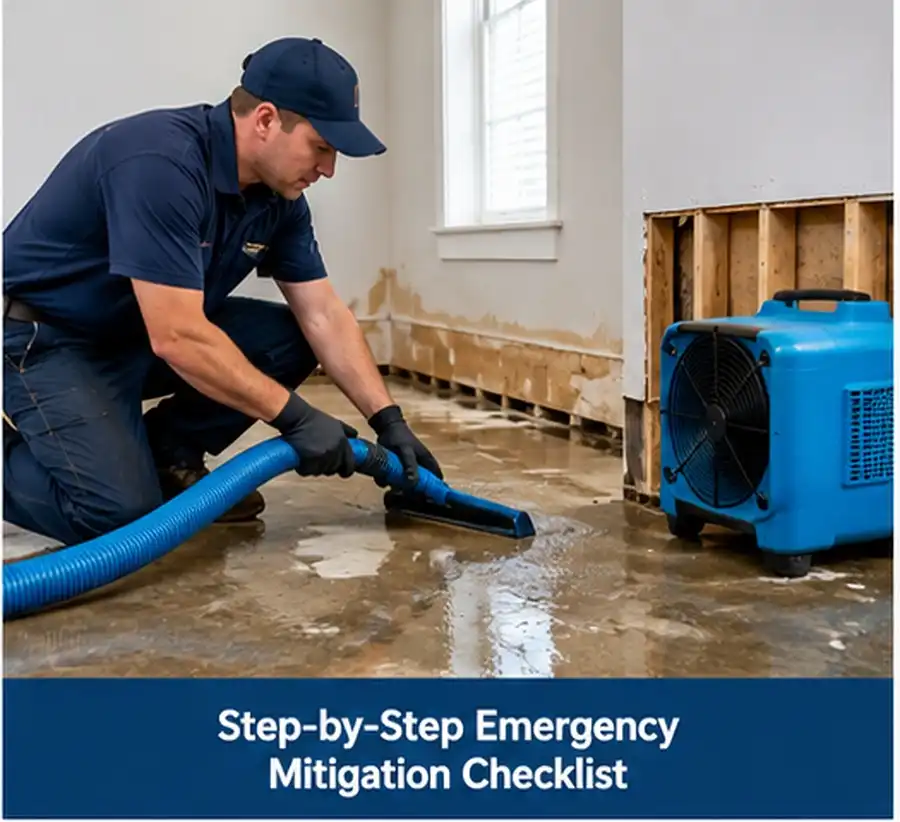
Steps to Stop Water Spreading
- Shut off the water source. Find your main shutoff valve (often in the basement or a front-yard meter pit).
- Cut the power to wet areas at the breaker panel if it’s safe to reach. Never stand in water to do it.
- Call (877) 679-6340 for 24/7 emergency dispatch.
- Photograph and video everything before you move anything.
- Move valuables such as electronics, documents, and rugs to a dry floor.
- Place foil or wood blocks under furniture legs to stop staining and wicking.
- Lift draperies and skirting off wet floors.
- Keep the HVAC off if water is near ducts or returns.
- Stay out of sewage water. Treat it as a hazard.
What Our Crews Do on Arrival
| Step | Action | Tools |
|---|---|---|
| 1. Assessment | Identify source, category, and class | Moisture meters, thermal imaging |
| 2. Moisture Mapping | Trace water hiding in walls and subfloors | Penetrating/non-penetrating meters |
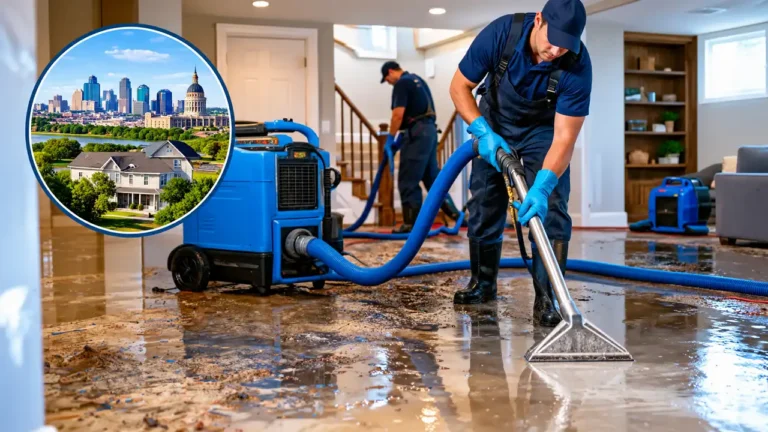
| 3. Extraction | Remove standing water | Truck-mounted and portable extractors |
| 4. Controlled Demo | Remove pad, baseboards, flood cuts as needed | Hand tools, HEPA vacuums |
| 5. Antimicrobial | Treat affected surfaces | EPA-registered products |
| 6. Drying Setup | Place air movers and dehumidifiers | LGR dehumidifiers, axial fans |
| 7. Daily Monitoring | Log readings until dry standard is met | Hygrometers, drying logs |
Pros and Cons: DIY vs. Professional Extraction
DIY (shop vac and box fans)
- ✅ Low upfront cost
- ✅ Fine for small Category 1 spills under a few square feet
- ❌ Can’t reach water inside wall cavities or under flooring
- ❌ No moisture documentation for insurance adjusters
- ❌ Box fans may spread spores if mold has already started
Professional extraction
- ✅ Removes far more water in the first pass
- ✅ Drying logs support your claim
- ✅ Thermal imaging finds hidden moisture
- ❌ Higher upfront cost (often covered by insurance)
If you’re unsure, call. Honest water damage mitigation Manhattan KS advice should tell you when a job is small enough to handle yourself.
Structural Drying Timelines & Equipment Metrics
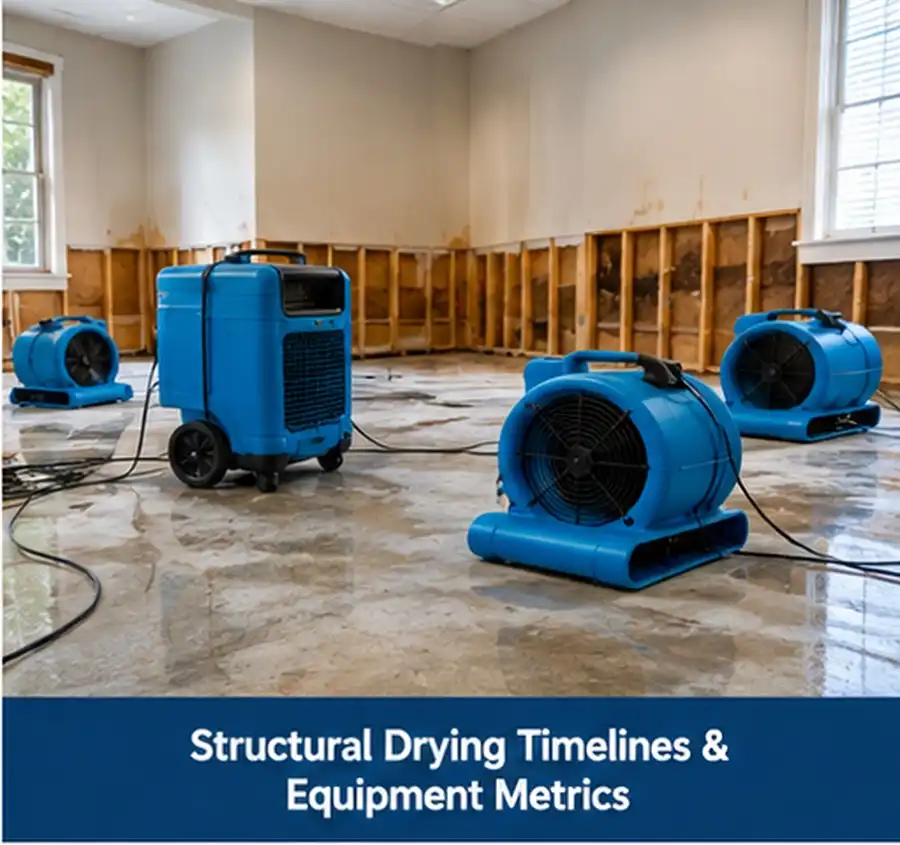
Structural drying is science, not guesswork. We measure relative humidity, material moisture content, and grains per pound every day. We pull equipment only when materials hit their dry standard, which is the reading from an unaffected area of the same material.
Typical Drying Timelines
| Scenario | Typical Drying Time | Key Factor |
|---|---|---|
| Small Category 1 leak, carpet and pad | 2 to 3 days | Fast extraction |
| Burst pipe, one room, drywall | 3 to 5 days | Cavity drying |
| Finished basement flood | 3 to 7 days | Concrete holds moisture |
| Hardwood floors (cupping) | 5 to 14 days | Floor drying mats |
| Plaster walls (older homes) | 5 to 10 days | Dense material, slow release |
| Category 3 sewage loss | 4 to 7 days after demo | Removal before drying |
Equipment Placement Metrics
| Equipment | General Placement Guideline | Purpose |
|---|---|---|
| Air movers | About 1 per 10 to 16 linear feet of wet wall, plus extra for wet floor areas | Pull moisture from surfaces |
| LGR dehumidifiers | Sized by cubic footage and class of water | Capture moisture from air |
| Desiccant dehumidifiers | Cold spaces, dense materials | Work in low temperatures |
| Wall cavity injection | Behind baseboards, small drill holes | Dry inside walls without demo |
| Floor drying mats | Over hardwood | Pull moisture up through boards |
| Air scrubbers (HEPA) | Contaminated or moldy areas | Capture airborne particles |
Drying Targets We Track
| Metric | Target |
|---|---|
| Indoor relative humidity | Below 60%, ideally 30% to 50% |
| Drywall | Matches dry standard of unaffected drywall |
| Wood framing/subfloor | Within a few points of dry standard |
| Daily logs | Recorded every visit for insurance |
If you’ve lived through a humid Kansas summer, our moisture containment protocol makes complete sense. We seal the drying zone with plastic sheeting so dehumidifiers aren’t fighting the whole house. Precise water damage mitigation Manhattan KS drying often saves drywall and trim that a rushed crew would tear out. Less demo means a smaller rebuild bill.
The IICRC S500 Standard: Why It Matters
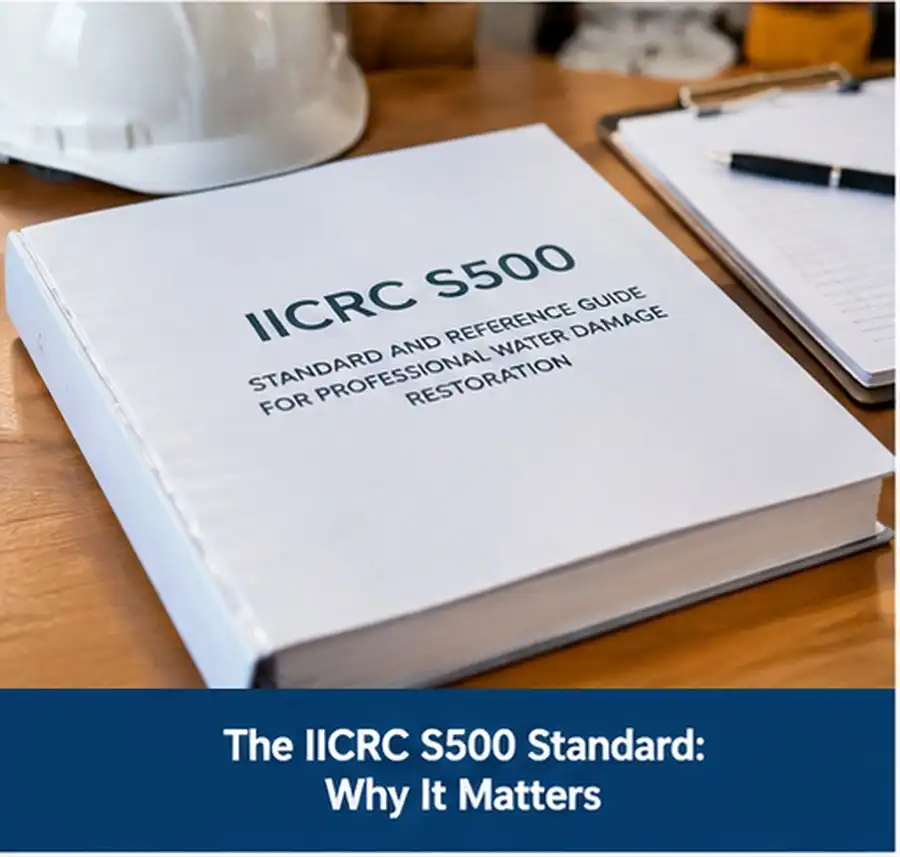
The ANSI/IICRC S500 is the industry’s Standard for Professional Water Damage Restoration. It sets out best practices for extraction, drying, safety, and mold prevention. Insurance carriers and adjusters use it to judge whether a job was done right.
| S500 Principle | What It Means for You |
|---|---|
| Category and class classification | Correct protocol from day one |
| Documented drying goals | Proof your home is actually dry |
| Contamination controls | Safe handling of gray and black water |
| Remove what can’t be restored | No hidden wet materials left behind |
Mold Prevention Protocols After Water Damage
Mold needs three things: spores, food (wood, paper, drywall), and moisture. We can’t remove all spores, so we control the moisture. According to the EPA’s Brief Guide to Mold, Moisture and Your Home, drying water-damaged areas and items within 24 to 48 hours usually prevents mold growth. The EPA also recommends keeping indoor humidity below 60%, ideally between 30% and 50%.
Mold Mitigation Checklist
- Stop the water source first. Cleaning mold without fixing the leak means it comes back.
- Extract and dry within 24 to 48 hours.
- Run dehumidifiers to hold humidity below 60%.
- Remove porous materials that stayed wet too long (carpet pad, ceiling tiles, insulation).
- Scrub hard surfaces with detergent and water, then dry them completely.
- Don’t paint or caulk over mold. The EPA notes paint over mold is likely to peel.
- Shut off the HVAC if you suspect mold near the system.
- Wear PPE: N-95 respirator, long gloves, and non-vented goggles.
- Call a pro if mold covers more than 10 square feet (the EPA’s threshold).
Containment Levels We Use
| Mold Area | Containment | Equipment |
|---|---|---|
| Under 10 sq ft | Limited, poly sheeting | HEPA vacuum, PPE |
| 10 to 100 sq ft | Full containment, sealed openings | Air scrubbers, negative air |
| Over 100 sq ft or HVAC involved | Full containment, negative pressure, decon chamber | Multiple scrubbers, full PPE |
An important note: The EPA says bleach is not recommended as a routine mold treatment. Dead mold can still trigger allergic reactions, so it must be physically removed. Our water damage mitigation Manhattan KS crews use HEPA removal and targeted antimicrobials instead of masking odors. A clean smell isn’t the same as a clean house.
Materials Mitigation: Salvage vs. Replace Guidelines
Not everything wet has to go. The decision depends on material type, water category, and how long it stayed wet.
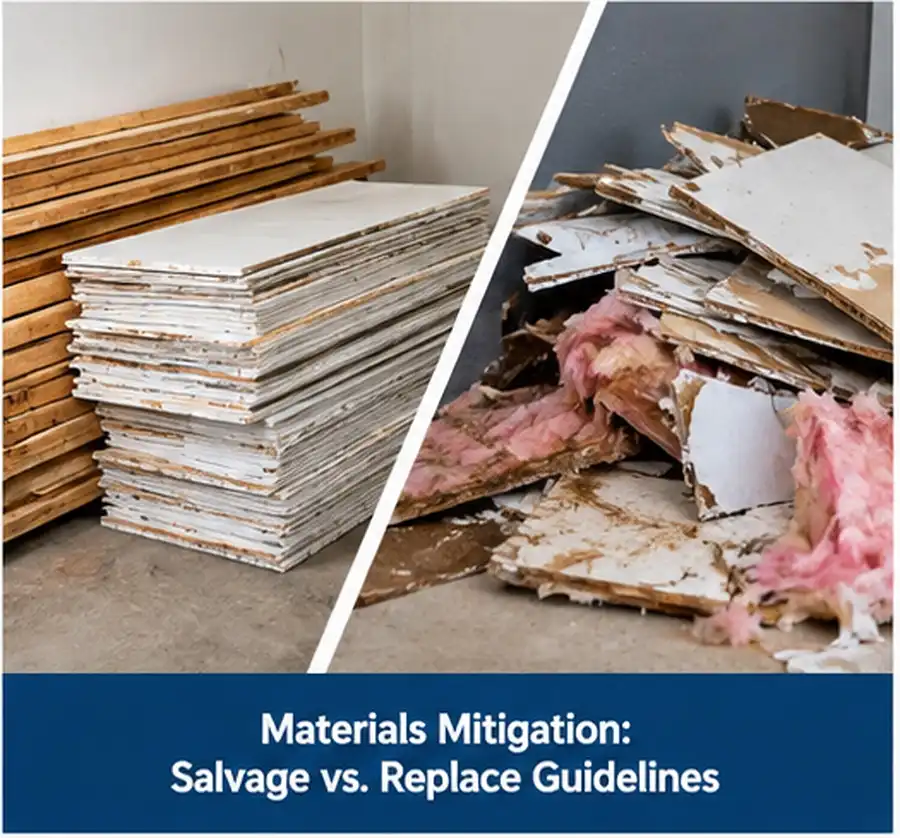
| Material | Category 1 (dried fast) | Category 2 | Category 3 |
|---|---|---|---|
| Carpet | Salvage | Case by case | Replace |
| Carpet pad | Often salvage | Replace | Replace |
| Drywall | Dry in place | Flood cut if saturated | Remove above wick line |
| Insulation (fiberglass batt) | Replace if compressed or wet | Replace | Replace |
| Hardwood flooring | Often salvage with mats | Case by case | Usually replace |
| Laminate flooring | Usually replace | Replace | Replace |
| Ceramic tile | Salvage | Clean and sanitize | Clean, sanitize, check grout |
| Plaster walls | Dry in place | Dry and treat | Assess, often remove |
| Wood cabinets (solid) | Dry in place | Case by case | Often replace |
| Particleboard cabinets | Often replace (swells) | Replace | Replace |
| Upholstered furniture | Professional cleaning | Case by case | Usually discard |
| Mattresses | Case by case | Discard | Discard |
| Documents/photos | Freeze-dry options | Specialist | Specialist or discard |
Pro tip: Before you throw anything out, photograph it and keep a small sample. FEMA’s NFIP guidance specifically asks policyholders to keep samples of carpet, flooring, and curtains. Smart water damage mitigation Manhattan KS planning saves both materials and claim value.
Estimated Repair Costs in Manhattan and Topeka, KS

We believe in transparent pricing. The ranges below are general estimates based on typical regional jobs. Your actual cost depends on square footage, water category, and materials affected. We provide a written estimate before major work begins.
| Service | Estimated Cost Range | Notes |
|---|---|---|
| Emergency water extraction | $3.75 to $7.00 per sq ft | Category 1 is lowest |
| Small leak mitigation (one room) | $1,000 to $3,000 | Extraction plus 3 days of drying |
| Burst pipe mitigation | $1,500 to $5,000 | Varies with wall and ceiling damage |
| Finished basement flood | $3,000 to $10,000+ | Pad, drywall, and baseboard removal |
| Sewage cleanup (Category 3) | $3,000 to $12,000+ | PPE, disposal, antimicrobials |
| Mold remediation | $1,500 to $6,000+ | Depends on containment level |
| Sump pump failure cleanup | $1,500 to $5,000 | Plus pump replacement |
| Toilet overflow cleanup | $500 to $3,000 | Category depends on contents |
| Rebuild (drywall, paint, flooring) | Quoted separately | After drying is verified |
What Drives Costs Up
- Delay. A Category 1 loss that sits becomes a Category 2 or 3 job.
- Hidden moisture. Water inside walls and under floors extends drying.
- Finished basements. More materials mean more removal.
- Older homes. Plaster and old-growth hardwood need longer, careful drying.
- Mold growth. Adds containment and removal steps.
Fast water damage mitigation Manhattan KS response is the single biggest factor in keeping your bill low. The first call is usually the cheapest decision you’ll make.
NFIP Flood Insurance Claim Steps
Flood losses from Wildcat Creek or the Blue River usually fall under flood insurance, not standard homeowners policies. The FEMA FloodSmart claim guide explains that an NFIP policy covers water entering your home from the ground up, such as flash flooding or overflowing rivers. It does not cover rain blown in by wind or water through a damaged roof.
Your Claim Checklist
- Report the loss to your insurance provider as soon as possible.
- Document everything. Take photos and videos, and record make, model, and serial numbers of appliances.
- Keep samples of carpet, flooring, and curtains.
- Discard health hazards (food, soaked pillows, carpet) only after documenting.
- Prevent mold. NFIP policies do not cover mold damage.
- Verify your adjuster. Ask to see their Flood Control Number card.
- Review the estimate carefully for accuracy.
- Talk to your adjuster before signing repair contracts.
- Expect 4 to 8 weeks for final payment.
Key NFIP Numbers
| Item | Detail |
|---|---|
| Typical claim timeline | 4 to 8 weeks |
| Advance payment (no adjuster visit) | Up to $5,000 during major events |
| Advance with documentation | Up to $20,000 |
| Average claim (2020 to 2024) | $82,614 |
| Basement coverage | Limited to installed items like furnaces, sump pumps, water heaters |
| Increased Cost of Compliance | Up to $30,000 in special flood hazard areas |
| Denied claim? | Appeal to your insurer or to FEMA |
Our drying logs and moisture maps give your adjuster clear proof of the work. Documented water damage mitigation Manhattan KS records often make the difference between a smooth claim and a dispute. Paperwork is part of the job.
Our Water Damage Service Catalog
At Topeka Water Damage Restoration, we handle every stage from emergency extraction to final drying. Each service below is available for Manhattan properties.
| Service | What We Do | When You Need It |
|---|---|---|
| Water Extraction | Truck-mounted and portable pumps remove standing water | Any active flooding |
| Water Removal | Full removal from carpet, pad, and floors | Leaks, overflows, spills |
| Flood Cleanup | Storm and river flood response, debris and silt removal | Wildcat Creek or Blue River flooding |
| Basement Water Removal | Pump-out, pad removal, concrete drying | Foundation seepage, heavy rain |
| Sewage Cleanup | Category 3 protocol, PPE, sanitizing | Sewer line backups |
| Burst Pipe Water Damage | Extraction, wall cavity drying | Winter freezes |
| Structural Drying | Air movers, LGR dehumidifiers, daily monitoring | After every water loss |
| Mold Remediation | Containment, HEPA removal, moisture correction | Musty odors, visible growth |
| Toilet Overflow Cleanup | Category 2/3 cleaning and drying | Bathroom overflows |
| Sump Pump Failure Cleanup | Emergency extraction, drying | Power outages, pump burnout |
Why Property Owners Choose Us
- 24/7 emergency response with live dispatch
- Local expertise in Kansas freeze cycles, spring floods, and summer humidity
- Advanced equipment, including thermal imaging and LGR dehumidifiers
- Transparent process with clear estimates and no hidden steps
- Jargon-free advice so you understand every decision
Full-service water damage mitigation Manhattan KS means one team, one plan, and one point of contact. You can browse our complete list on our services page.
Serving Manhattan Neighborhoods and Riley County
Manhattan’s housing mix creates different water problems in different areas. Here’s what we see most often.
| Area | Common Issues | Our Typical Response |
|---|---|---|
| Downtown Manhattan | Aging infrastructure, older plumbing, plaster walls | Careful plaster drying, supply-line leak tracing |
| Northview | Basement flooding after heavy rain | Pump-out, pad removal, concrete drying |
| Bluemont | Older homes, slow hidden leaks, basement seepage | Moisture mapping, wall cavity drying |
| Kansas State University area / Aggieville | Student rentals, unreported leaks, apartment overflows | Fast extraction, landlord documentation |
| Wildcat Creek corridor | Flash flood Category 3 water | Full sanitizing, flood cut, antimicrobials |
| Rural Riley County | Sump pump failures, well and septic issues | Emergency pump-out, sewage protocol |
One Northview homeowner called after heavy rains flooded their basement. We extracted the water, dried the space, and returned it to a safe, livable condition in three days. Near campus, we’ve dried and sanitized water-damaged apartments so tenants could move back in with no lingering mold or odors. That’s the standard we hold on every job.
FAQs
How fast should water damage be addressed?
Within 24 to 48 hours. After that, mold risk rises sharply and clean water can degrade into gray water.
Does homeowners insurance cover water damage?
Usually for sudden, accidental events like burst pipes. Flood damage typically needs a separate flood policy. Long-term leaks and mold are often excluded.
Can I stay in my home during drying?
Often yes for Category 1 losses. For sewage or heavy mold, we usually recommend staying elsewhere.
How do I know my home is truly dry?
We confirm with moisture meters against your home’s dry standard, not by touch. You get the drying logs.
Do you work with landlords and property managers?
Yes. We serve rental properties and multi-unit buildings, with documentation for owners and tenants.
Get 24/7 Emergency Help in Manhattan, KS
Water damage doesn’t wait for business hours, and neither do we. Our crews are on call day and night to stop the water, dry your structure, and protect your claim.
📞 Call (877) 679-6340 for immediate dispatch, or request service online.
Topeka Water Damage Restoration provides fast response, honest advice, and drying done right for Manhattan, Riley County, and surrounding communities.
One Comment