Stop the Spread: How Water Damage Restoration Shawnee County Crews Save Topeka Homes From Mold and Structural Rot
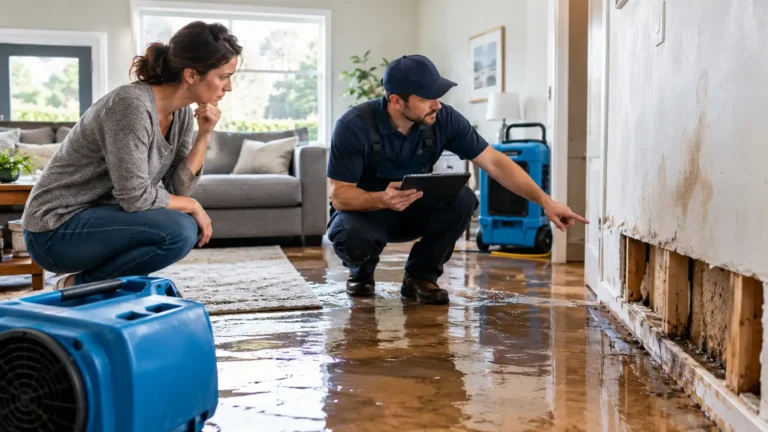
A cracked supply line can dump hundreds of gallons of water into your home before you notice it. Within 24 to 48 hours, that water wicks into drywall, subfloors, and framing, and mold spores start to colonize. Fast, professional water damage restoration Shawnee County homeowners can count on is the difference between a three-day drying job and a gut-and-rebuild project.
Here is the “so what” for you. Every hour of standing water raises your repair bill, your mold risk, and the chance your insurance adjuster pushes back on the claim. At Topeka Water Damage Restoration, we answer calls 24/7 and aim to have crews on site within 60 minutes. This article shows you exactly what happens during a professional response, what it costs in Topeka, and how to protect your claim.
Key Takeaways
- Act inside 24 to 48 hours. Mold can begin growing on wet materials within this window. Shut off the water, kill power to wet areas, and call a certified crew immediately.
- Water category drives everything. Clean Category 1 water can often be dried in place. Category 3 black water (sewage, creek, or river flooding) means porous materials must be removed and discarded.
- Document before you clean. Photos, videos, and moisture readings taken before tear-out are your strongest evidence for an insurance claim.
Know Your Water: IICRC Categories and Classes Explained
Every job we run starts with two questions. Where did the water come from? And how far has it spread? The answers come from the IICRC S500 Standard, the industry rulebook for professional water damage work. You can review the standard directly through the Institute of Inspection, Cleaning and Restoration Certification (IICRC S500).
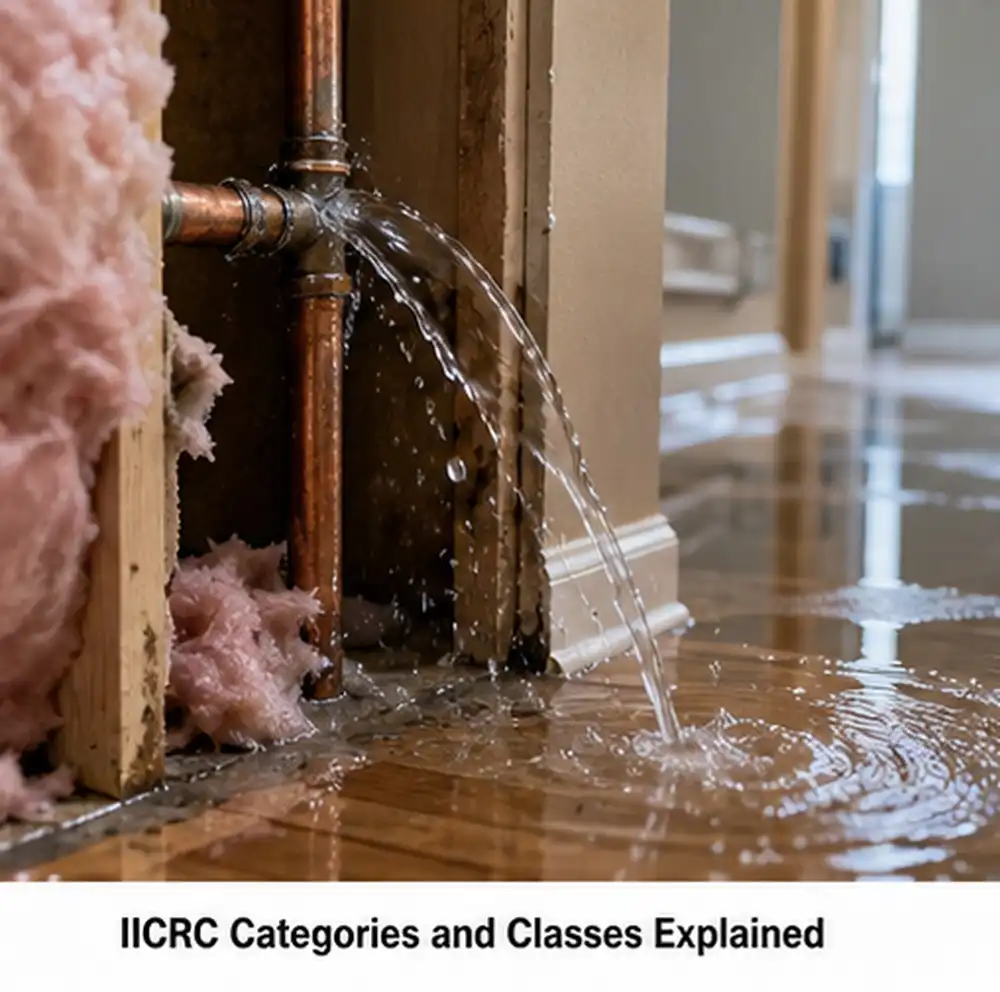
Our technicians classify the water before a single air mover goes down. That classification decides what we save, what we tear out, and what protective gear our crews wear. It is the backbone of reliable water damage restoration Shawnee property owners should expect from any contractor.
Water Damage Category Comparison (Category 1 Clean vs. Category 3 Black Water)
| Factor | Category 1: Clean Water | Category 2: Gray Water | Category 3: Black Water |
|---|---|---|---|
| Common Sources | Burst supply lines, faucet leaks, water heater failures | Washing machine overflow, dishwasher leaks, toilet overflow (urine only), some sump failures | Sewage backups, toilet overflow with feces, Shunga Creek or Kansas River flood water |
| Health Risk | Low | Moderate (can cause illness) | High (bacteria, viruses, chemicals) |
| Porous Materials | Often dried in place | Clean, sanitize, case-by-case removal | Remove and discard |
| Carpet Pad | Usually salvageable if dried fast | Typically replaced | Always discarded |
| PPE Required | Gloves, boots | Gloves, boots, eye protection | Full PPE, respirators, containment |
| Time Before Downgrade | Can become Category 2 in about 48 hours | Can become Category 3 as bacteria grow | Already the highest risk level |
| Antimicrobial Treatment | As needed | Recommended | Mandatory |
Water Damage Classes (How Much Is Wet)
| Class | What It Means | Typical Topeka Example | Drying Difficulty |
|---|---|---|---|
| Class 1 | Small area, low-porosity materials | Kitchen sink leak on vinyl plank | Easy |
| Class 2 | Whole room, water wicked up to 24 inches on walls | Washer overflow into a carpeted family room | Moderate |
| Class 3 | Water from above, saturated ceilings, walls, insulation | Upstairs bathroom pipe burst in Potwin | High |
| Class 4 | Specialty drying: hardwood, plaster, concrete, brick | Flooded basement with original plaster in Westboro | Highest |
Our restoration crews frequently encounter Class 4 conditions in historic Westboro basements. Those plaster-and-lath walls and dense hardwood floors hold moisture like a sponge. They need specialty drying, not just extra fans.
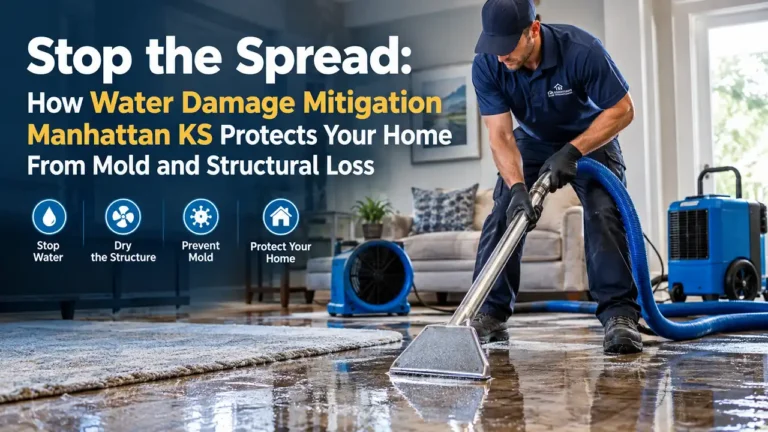
Check Also: How Water Damage Mitigation Manhattan KS Protects Your Home From Mold and Structural Loss
The First 60 Minutes: Emergency Water Extraction
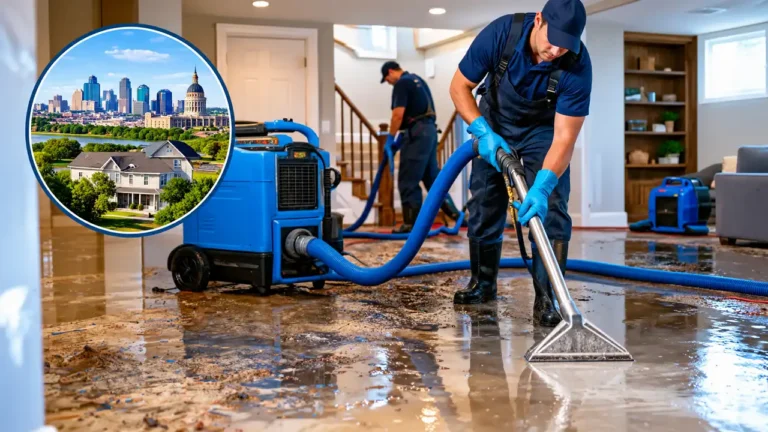
The first hour sets the tone for the whole job. Standing water is the heaviest moisture load in your home. Removing it fast with truck-mounted or portable extraction units cuts drying time by days. That is why a quick water damage restoration Shawnee response focuses on water extraction and water removal first.
On recent emergency service calls in College Hill, we found homeowners had spent hours with shop vacs and towels. The effort was well meant. But a shop vac pulls a fraction of what commercial extractors remove, and the water kept wicking into walls the whole time.
Steps to Stop Water Spreading (Before We Arrive)
- Shut off the main water valve. In most Topeka homes, it sits in the basement near the front foundation wall or by the water heater.
- Kill power to wet areas at the breaker panel. Never step into standing water near outlets or appliances.
- Stop the source if it is safe. Turn off the toilet supply valve or unplug a failing sump.
- Move valuables up and out. Lift furniture onto foil squares or wood blocks to prevent staining.
- Pull up area rugs and remove items from the floor.
- Take photos and video of everything before you move or toss it.
- Open interior doors for airflow, but keep windows closed during humid Kansas summers.
- Call a certified crew. Our line is open 24/7 at (877) 679-6340.
Pro/Con Extraction Protocols
| Method | Pros | Cons | Best Use |
|---|---|---|---|
| Truck-Mounted Extraction | Massive suction, fastest removal | Needs driveway access, hose runs | Large floods, basements |
| Portable Extractors | Fits tight spaces, upper floors | Lower capacity than truck units | Apartments, NOTO Arts District lofts |
| Weighted Extraction Tools | Squeezes water out of carpet pad | Slower per square foot | Saturated carpet you hope to save |
| Submersible Pumps | Moves deep standing water | Cannot remove surface moisture | Basement water over 2 inches |
| DIY Shop Vac | Available right now | Low suction, leaves pad soaked | Small spills only |
Structural Drying: Timelines, Targets, and Equipment
Extraction removes the water you can see. Structural drying removes the water you cannot see. It hides in wall cavities, subfloors, and framing lumber. Professional water damage restoration Shawnee work is measured by moisture readings, not by how the room looks.
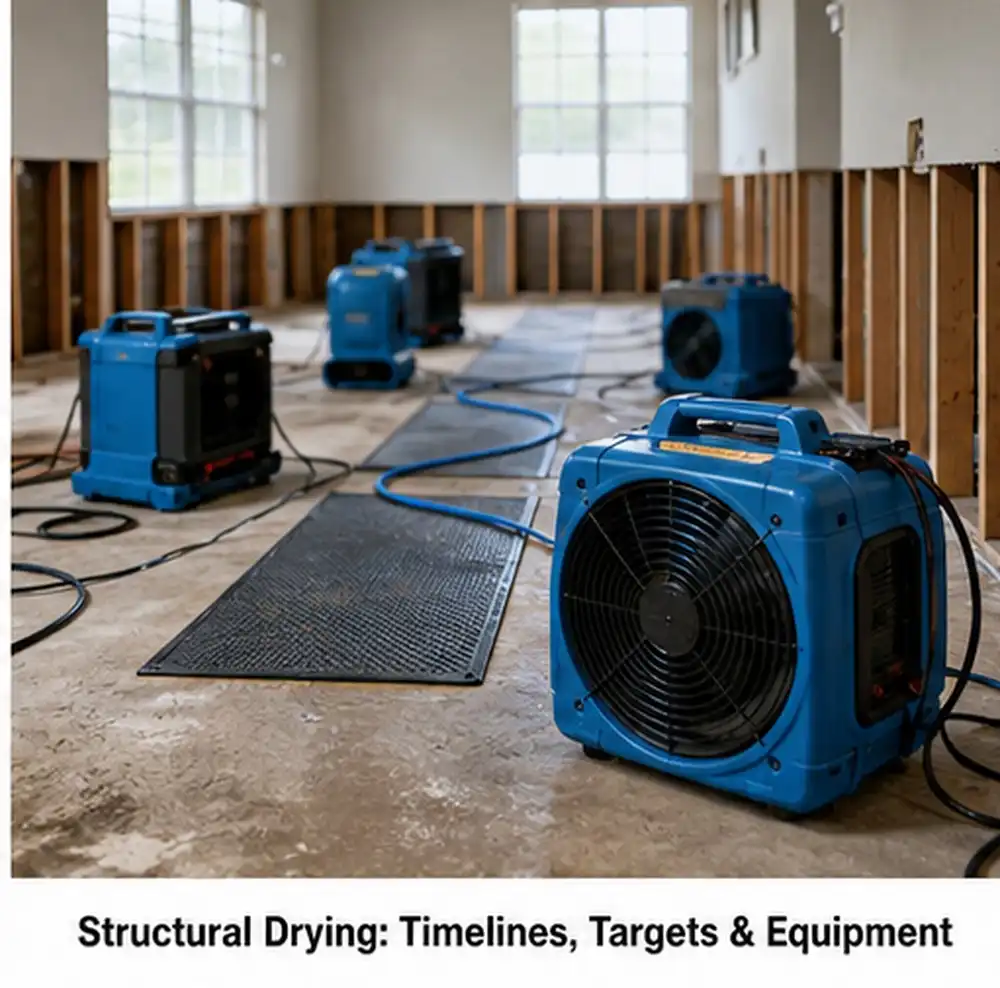
We set a dry standard by measuring unaffected materials in your home. Then we track moisture content, relative humidity, and grains per pound (GPP) daily. We do not pull equipment until the numbers say the structure is dry.
If you’ve lived through a humid Topeka summer, this moisture containment protocol makes complete sense. Outdoor humidity in July can sit above 70%. Opening windows can actually push more moisture into a wet structure.
Structural Drying Timelines & Equipment Metrics
| Material | Dry Target | Typical Drying Time | Primary Equipment |
|---|---|---|---|
| Drywall | Match the dry standard (unaffected wall reading) | 2 to 3 days | Air movers, LGR dehumidifiers |
| Wood Framing / Studs | About 12% to 15% moisture content | 3 to 5 days | Air movers, wall cavity injection |
| Hardwood Flooring | Within 2% to 4% of unaffected wood | 5 to 14 days | Floor drying mats, desiccant dehumidifiers |
| Concrete Slab | Match dry standard on surface and depth readings | 3 to 7+ days | Heat drying, dehumidifiers |
| Plaster and Lath | Match dry standard | 5 to 10 days | Injection drying, desiccant units |
| Subfloor (OSB/Plywood) | About 12% to 15% | 3 to 6 days | Air movers, top-down and crawlspace drying |
Equipment Placement Guidelines
| Equipment | Placement Rule of Thumb | What It Does |
|---|---|---|
| Air Movers | About 1 per 10 to 16 linear feet of wet wall, plus 1 per 50 to 70 sq ft of wet floor | Pushes moisture off surfaces into the air |
| LGR Dehumidifiers | Sized by cubic footage and water class | Pulls water vapor from the air |
| Desiccant Dehumidifiers | Used in cold or very dense materials | Dries where refrigerant units struggle |
| HEPA Air Scrubbers | Sized for 4 or more air changes per hour in contained areas | Captures mold spores and dust |
| Moisture Meters & Thermal Cameras | Daily readings at mapped points | Proves the structure is dry |
Materials Mitigation: Salvage vs. Replace Guidelines
This table reflects how we decide what to keep. It lines up with the IICRC S500 and the EPA’s flooded homes guidance on what can be cleaned and what should go.
| Material | Category 1 | Category 2 | Category 3 |
|---|---|---|---|
| Carpet | Dry in place | Clean, sanitize, evaluate | Discard |
| Carpet Pad | Dry if extracted quickly | Replace | Discard |
| Drywall | Dry in place if wet under 48 hrs | Flood cut if wicking is high | Flood cut 2 ft above water line |
| Fiberglass Insulation | Usually replace when soaked | Replace | Discard |
| Solid Hardwood Floors | Dry with floor mats | Dry and sanitize, case-by-case | Usually replace |
| Solid Wood Furniture | Clean and dry | Clean and disinfect | Clean, disinfect, evaluate |
| Upholstered Furniture | Professional drying | Evaluate | Discard |
| Mattresses & Cushions | Evaluate | Discard | Discard |
| Metal, Glass, Ceramics | Clean | Clean and disinfect | Clean and disinfect |
| Photos & Documents | Air dry or freeze | Freeze and restore | Freeze, professional restoration |
Check Also: How Sewage Cleanup Kansas City Standards Protect Your Topeka Home
Mold Remediation: Stopping Growth Before It Spreads
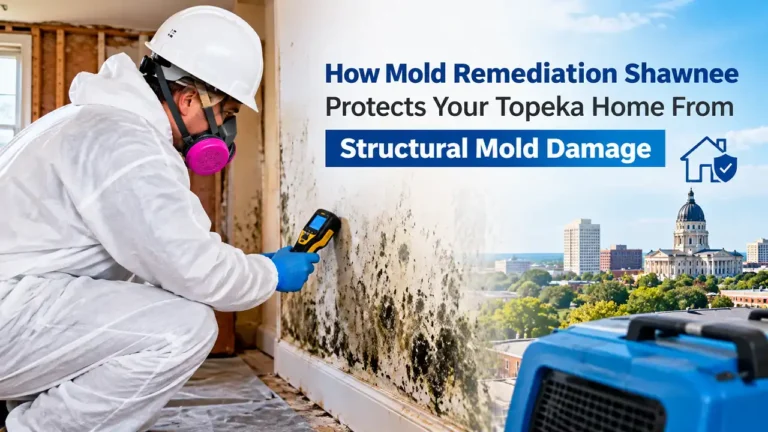
Mold does not wait for your insurance adjuster. According to the EPA’s official mold guidance, drying wet materials within 24 to 48 hours is the key to preventing growth. Miss that window, and professional mold remediation becomes part of the job.
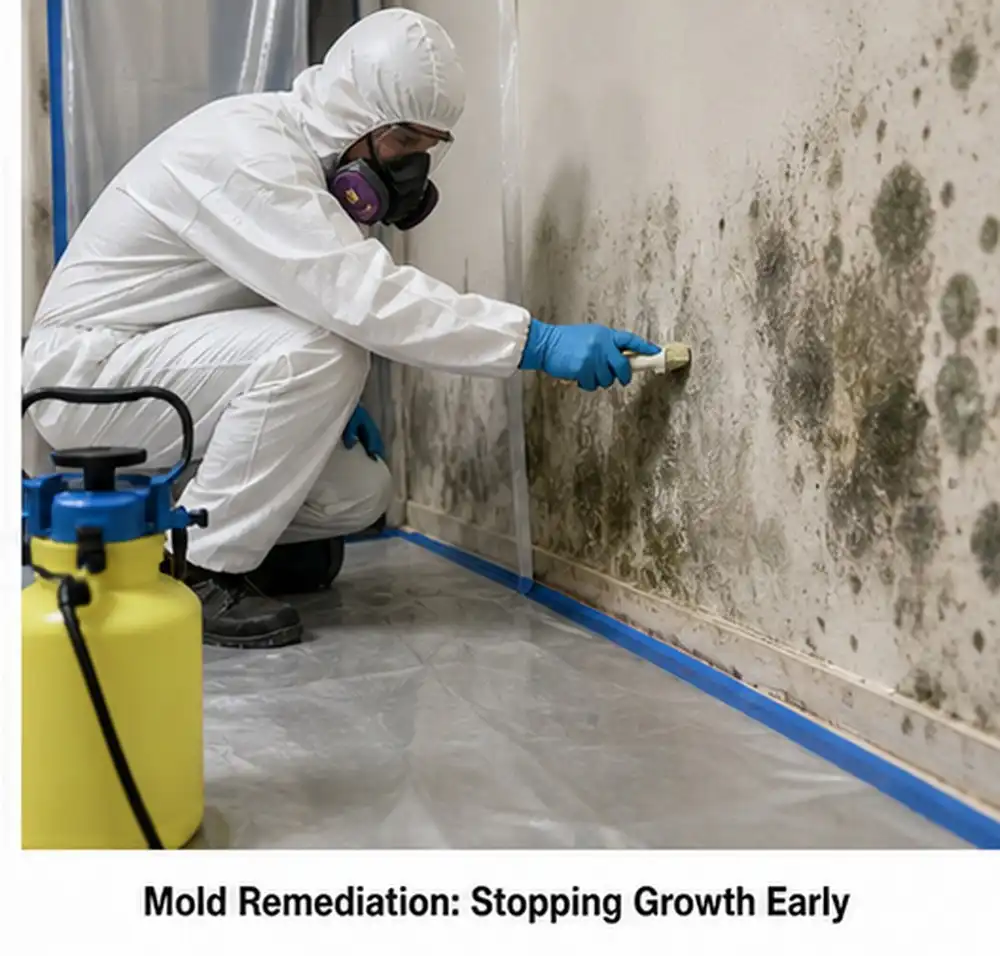
Topeka’s climate makes this worse. Humid summers and poorly ventilated basements give mold everything it wants. We see it most in Highland Park and Sherwood homes where finished basements trap moisture behind paneling. Trusted water damage restoration Shawnee property owners rely on treats mold remediation as part of drying, not an afterthought.
The EPA notes that homeowners can usually handle mold covering less than about 10 square feet. Anything larger, anything in your HVAC system, or any mold tied to sewage calls for a trained crew.
Mold Mitigation Checklist
- Fix the moisture source first. Killing mold without stopping the leak is wasted money.
- Set up containment. We seal work areas with 6-mil poly sheeting and zipper doors.
- Create negative air pressure. HEPA air scrubbers vent outdoors so spores do not drift into clean rooms.
- Wear proper PPE. N95 or better respirators, gloves, and eye protection at minimum.
- Remove porous moldy materials. Drywall, insulation, and carpet pad with growth get bagged and discarded.
- HEPA vacuum all surfaces inside containment.
- Clean and treat framing with an EPA-registered antimicrobial.
- Dry the structure to the dry standard before any rebuild.
- Verify results. Visual inspection, moisture readings, and clearance testing when needed.
Warning Signs Mold Is Already Growing
| Sign | What It Usually Means |
|---|---|
| Musty, earthy odor | Active growth, often hidden in walls or under flooring |
| Bubbling paint or wallpaper | Moisture trapped behind the surface |
| Dark spotting near baseboards | Wicking water fed growth from below |
| Warped or cupped flooring | Subfloor moisture; mold likely underneath |
| Allergy symptoms that improve outside | Indoor spore levels may be elevated |
Specialty Water Losses We Handle Across Shawnee County
Not every loss looks the same. A frozen pipe in January and a sewer backup after a spring storm need very different protocols. Our full service catalog covers every common scenario, and dependable water damage restoration Shawnee homeowners trust should match the right protocol to the right loss.
Our Core Service Catalog at a Glance
| Service | Common Trigger in Topeka | Water Category | Key Step |
|---|---|---|---|
| Flood Cleanup | Spring flash floods, Shunga Creek overflow | Category 3 | Remove porous materials, disinfect |
| Basement Water Removal | Heavy rain, foundation seepage | Category 1 to 3 | Pump, extract, dry slab and walls |
| Burst Pipe Water Damage | Winter freeze cycles | Category 1 | Fast extraction, wall cavity drying |
| Sewage Cleanup | City main backups, root intrusion | Category 3 | Containment, removal, sanitization |
| Sump Pump Failure Cleanup | Power outages during storms | Category 2 to 3 | Extraction, antimicrobial, drying |
| Toilet Overflow Cleanup | Clogs, failed fill valves | Category 2 to 3 | Subfloor check, sanitize, dry |
Burst Pipe Restoration
Kansas winters are brutal on plumbing. When temperatures drop into the teens or below, pipes in exterior walls, crawlspaces, and unheated garages freeze and split. The burst often happens as the pipe thaws, so water starts flowing hours after the cold snap.
- Older Potwin and College Hill homes often have galvanized lines in exterior walls.
- Ranch homes in Tecumseh and Berryton commonly see failures in crawlspace runs.
- Water from a supply line is Category 1, so fast action usually means drying in place.
- Wait too long, and that clean water degrades into Category 2 with higher costs.
Basement Flood Cleanup
Basements are where Topeka water damage ends up. Gravity guarantees it. Saturated clay soil, heavy spring rain, and aging foundations all push water inside.
- Pump out deep water with submersible pumps.
- Extract remaining water from carpet and slab.
- Flood cut drywall above the wicking line.
- Remove wet insulation and paneling.
- Dry the concrete slab and block walls with dehumidifiers and air movers.
- Apply antimicrobial to framing and slab.
- Verify dryness with moisture mapping before rebuild.
Sump Pump Failure
Most sump pumps fail at the worst possible moment: during a storm-related power outage. We see this every spring in Auburn and Sherwood neighborhoods with high water tables.
| Failure Cause | Prevention Tip |
|---|---|
| Power outage | Install a battery backup or water-powered backup pump |
| Stuck float switch | Test monthly by pouring a bucket of water into the pit |
| Undersized pump | Match horsepower to your pit inflow rate |
| Clogged discharge line | Clear debris and protect the outlet from freezing |
| Pump age over 7 to 10 years | Replace proactively |
Sewage Cleanup
Sewage backups are always Category 3. They carry bacteria, viruses, and parasites. This is not a DIY job.
- Stay out of the affected area, especially children, pets, and anyone with a weak immune system.
- Do not run water or flush toilets until the line is cleared.
- Expect removal of carpet, pad, drywall, and insulation that touched the water.
- We disinfect every surface and use HEPA air scrubbers during cleanup.
Toilet Overflow Cleanup
A toilet overflow seems small. But water travels under vinyl flooring, into subfloors, and through ceilings below. On a recent call in the NOTO Arts District, a second-floor overflow showed up as a ceiling stain in the unit below two days later.
- Clean overflows (Category 2): extract, sanitize, and dry the subfloor.
- Overflows with waste (Category 3): remove affected porous materials.
- Always check the ceiling below with a moisture meter or thermal camera.
Costs, Coverage, and Your Insurance Claim Strategy
Two questions follow every emergency call. What will this cost? And will insurance pay?

We believe in transparent pricing, so here are real-world ranges. Every water damage restoration Shawnee estimate we write starts with a free on-site inspection before final numbers.
Estimated Repair Costs in Topeka, KS
| Service | Typical Cost Range | Main Cost Drivers |
|---|---|---|
| Category 1 Extraction & Drying | $3.50 to $7.00 per sq ft | Affected square footage, drying days |
| Category 2 Gray Water Cleanup | $4.50 to $8.50 per sq ft | Sanitizing, pad replacement |
| Category 3 Sewage/Flood Cleanup | $7.00 to $13.00 per sq ft | Material removal, PPE, disinfection |
| Burst Pipe Restoration | $1,500 to $8,000 | Floors affected, ceiling damage |
| Basement Flood Cleanup (Finished) | $3,000 to $15,000+ | Drywall, flooring, contents |
| Sump Pump Failure Cleanup | $1,500 to $6,000 | Water depth, finished vs. unfinished |
| Toilet Overflow Cleanup | $500 to $3,000 | Floors below, subfloor damage |
| Mold Remediation | $1,500 to $6,500 typical; $10,000+ for large areas | Square footage, containment, HVAC |
| Drying Equipment (per day) | Air movers about $25 to $40; dehumidifiers about $75 to $150 | Number of units, drying duration |
These figures are general estimates for planning only. Your actual cost depends on the category, class, and materials involved.
What Insurance Usually Covers
| Loss Type | Standard Homeowners Policy | Notes |
|---|---|---|
| Sudden burst pipe | Usually covered | Must be sudden and accidental |
| Slow, long-term leak | Usually denied | Treated as maintenance neglect |
| Sewer backup | Only with endorsement | Check your policy for a water backup rider |
| Sump pump failure | Only with endorsement | Often bundled with sewer backup coverage |
| River or surface flooding | Not covered | Requires NFIP or private flood insurance |
| Mold | Often capped or excluded | Coverage usually tied to a covered water event |
Flood damage from the Kansas River or Shunga Creek is a separate animal. Standard policies exclude it. Coverage comes through the National Flood Insurance Program, managed by FEMA. You can review policy details through FEMA’s NFIP flood insurance resources.
Keep these NFIP facts in mind:
- New policies usually carry a 30-day waiting period before coverage begins.
- You generally must file a signed Proof of Loss within 60 days of the flood.
- Basement coverage is limited. NFIP covers items like furnaces and water heaters, but not most finished basement contents.
Insurance Claim Steps That Protect Your Payout
- Stop further damage. Policies require you to take reasonable steps to mitigate loss.
- Photograph and video everything before cleanup begins, including water lines on walls.
- Call your insurer and get a claim number the same day.
- Hire a certified mitigation company. Our crews document daily moisture readings and drying logs.
- Keep damaged samples. Save a piece of carpet, pad, or drywall until the adjuster sees it.
- Save every receipt for hotel stays, meals, and emergency purchases.
- Request the adjuster’s estimate in writing and compare it to ours line by line.
- Submit your Proof of Loss on time for flood claims.
- Do not sign a final settlement until all hidden damage is identified.
We work directly with adjusters every week. Clear moisture data is often what turns a disputed claim into an approved one.
Why Topeka Property Owners Call Us First
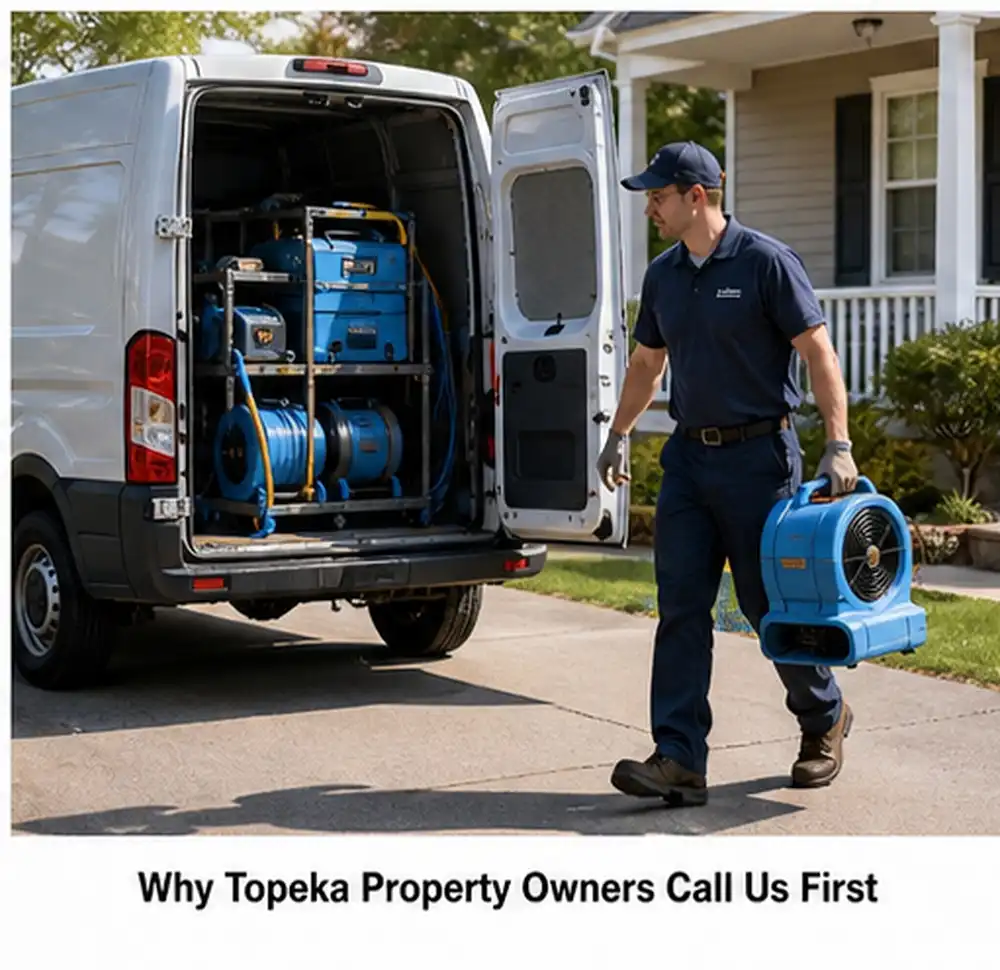
We are not a call center that dispatches strangers. Our crews live and work across Shawnee County, from Westboro to Berryton. We know which neighborhoods flood, which homes have plaster walls, and which streets lose power in storms.
| What You Get | How We Deliver It |
|---|---|
| 24/7 Emergency Response | Live answer any hour; crews aim to arrive within 60 minutes |
| IICRC-Based Methods | Category, class, and drying goals per the S500 standard |
| Transparent Process | Clear communication and no hidden steps |
| Advanced Equipment | Truck-mounted extraction, LGR and desiccant dehumidifiers, thermal imaging |
| Insurance Support | Photo logs, moisture maps, and drying reports ready for your adjuster |
| Jargon-Free Advice | Plain answers on what to save, what to toss, and why |
FAQs
How fast should water damage be dried?
Aim to start drying within 24 hours and finish critical drying fast. The EPA warns mold can grow within 24 to 48 hours on wet materials.
Can I stay in my home during restoration?
Usually, yes, for Category 1 jobs. For sewage or heavy mold, we often recommend staying elsewhere until containment and cleaning are complete.
How long does structural drying take?
Most homes dry in 3 to 5 days. Hardwood floors, plaster, and concrete can take longer. We confirm with daily moisture readings.
Do you serve areas outside Topeka?
Yes. We cover Tecumseh, Auburn, Berryton, and all Topeka neighborhoods, including Highland Park, Sherwood, and Potwin.
What should I do right now?
Shut off the water, cut power to wet areas, take photos, and call us at (877) 679-6340. We will walk you through the next steps on the phone while our crew is on the way.
Water damage is not a wait-and-see problem. Every hour matters for your structure, your health, and your claim. Request a free estimate or call (877) 679-6340 now, and our team will be on the road to your door.