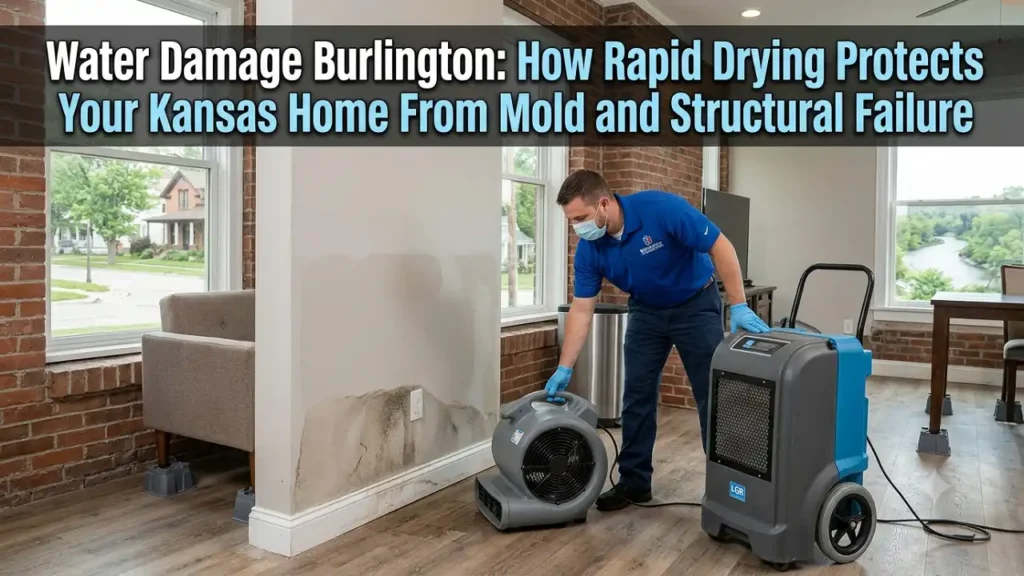
Standing water starts wicking into drywall within minutes. Within 24 to 48 hours, it can feed mold growth inside your walls. When you face water damage Burlington homeowners know well, from Neosho River high water to a split supply line in January, those first two days decide the outcome: you either dry a room or rebuild it.
This article walks you through what to do, in order. You get extraction checklists, drying metrics, mold protocols, salvage rules, cost ranges, and insurance steps. We wrote it from years of field work across Topeka and Coffey County. Every table is built so you can act fast, even while the water is still on the floor.
Key Takeaways
- Stop the source and call within the first hour. Every hour of delay pushes water deeper into framing, subfloors, and insulation, raising your final repair bill.
- Dry within 24 to 48 hours to prevent mold. The CDC sets this window for flood cleanup, and indoor humidity should stay at or below 50% afterward.
- Standard homeowners policies rarely cover river or surface flooding. You need a separate NFIP flood policy, and new policies carry a 30-day waiting period.
Why Burlington, KS Properties Face Higher Water Damage Risk
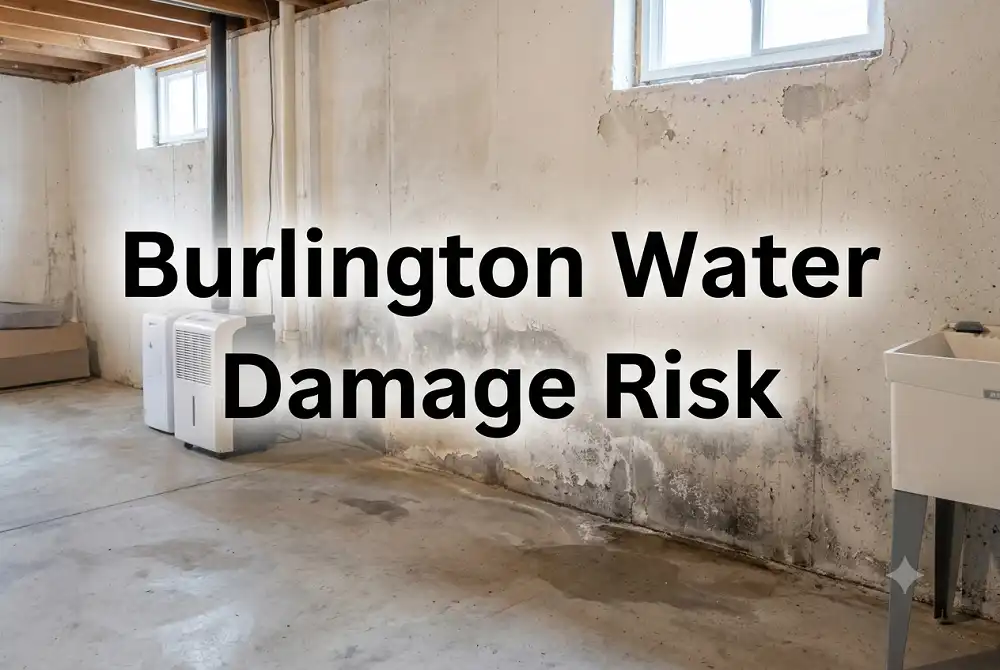
Burlington properties face water threats from the river, the sky, and the plumbing. The town sits along the Neosho River, just downstream of John Redmond Reservoir. Heavy spring rain across east-central Kansas raises the river, saturates soil, and pushes groundwater against basement walls. Then winter brings hard freezes that split exposed pipes.
The same pattern repeats in nearby Lebo, Waverly, and Le Roy. Rural properties add well systems, septic tanks, and crawl spaces, each with its own failure points. Location shapes the damage you get.
Check Also: How Sewage Cleanup Overland Park Crews Protect Your Home From Structural Mold Damage
Common Causes by Season
| Season | Primary Threat | What Our Crews See Most | Your First Move |
|---|---|---|---|
| Spring (Mar to Jun) | Flash floods, river rise | Basement seepage, sump pump overload | Test your sump pump before April |
| Summer (Jun to Aug) | Humidity, severe storms | Mold growth, roof leaks, AC drain overflows | Keep indoor RH under 50% |
| Fall (Sep to Nov) | Clogged gutters, storms | Foundation seepage, ceiling stains | Clear gutters and extend downspouts |
| Winter (Dec to Feb) | Freezing temps | Burst pipes, ice dams | Insulate pipes in exterior walls |
Older Homes Carry Hidden Risk
Our restoration crews frequently encounter this in historic Westboro basements in Topeka. Older Burlington homes share the same weak points: fieldstone or block foundations, galvanized supply lines, and cast-iron drains. These materials fail slowly, then all at once.
Most water damage Burlington calls we take start with one of three sources: a frozen pipe, a failed sump pump, or surface water entering through the foundation. Knowing your source tells us the water category, and the category sets the entire restoration plan.
Walk your basement this week and note every stain, efflorescence line, or musty odor. Those are your early warning signs.
Water Damage Category Comparison: Category 1 Clean vs. Category 3 Black Water
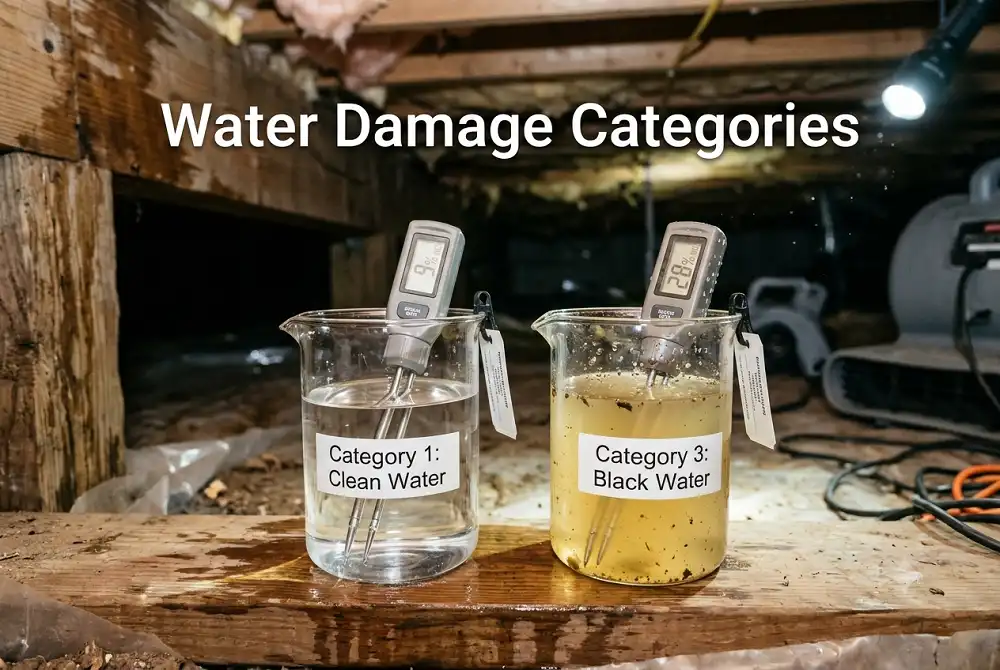
Water category determines how safely your materials can be saved. The IICRC S500 standard (the industry’s reference for professional water damage restoration) sorts water into three categories by contamination level. A higher category means more removal, more protective gear, and higher cost.
| Factor | Category 1: Clean Water | Category 2: Gray Water | Category 3: Black Water |
|---|---|---|---|
| Typical sources | Supply line, burst pipe, rainwater from roof | Washing machine, dishwasher, toilet overflow (urine only) | Sewage backup, river flooding, ground surface water |
| Health risk | Low at first | Moderate; can cause illness | High; bacteria, viruses, chemicals |
| Carpet pad | Often salvageable | Replace | Replace |
| Carpet | Often salvageable | Clean and sanitize, sometimes replace | Replace |
| Drywall | Dry in place if caught early | Remove if soaked | Remove 12 to 24 inches above water line |
| Protective gear | Gloves | Gloves, eye protection | Full PPE, respirator |
| Time to degrade | Becomes Cat 2 in about 48 hours | Becomes Cat 3 in about 48 hours | Already contaminated |
Category is not fixed. Clean water sitting on carpet for two days picks up contaminants and downgrades to Category 2. That’s why fast response matters more than almost anything else.
Check Also: Fire Damage Mitigation Shawnee: How Fast Action Stops Smoke, Soot, and Mold From Destroying Your Home
Water Damage Classes: How Much Is Wet
The class (how much material absorbed water) is separate from the category. Class drives equipment count and drying time.
| Class | Description | Example |
|---|---|---|
| Class 1 | Small area, low-porosity materials | Bathroom tile floor after a toilet leak |
| Class 2 | Whole room, water wicked up to 24 inches on walls | Laundry room flood into carpet |
| Class 3 | Water from overhead; ceilings, walls, insulation saturated | Burst pipe in an attic |
| Class 4 | Specialty drying: hardwood, plaster, concrete | Flooded basement slab or oak floors |
For any water damage Burlington river flooding causes, assume Category 3 until a technician tests it. Keep children and pets out of the area until then.
Emergency Water Extraction Checklist: Steps to Stop Water Spreading
The first 60 minutes control the scope of the loss. Water spreads sideways under flooring and climbs walls through capillary action (the wicking effect that pulls water up porous materials). Your goal is to stop the source, protect people, and limit migration.
Your First 60 Minutes
- Shut off the main water valve. Most Burlington homes have it in the basement or near the water heater. On rural wells, turn off the well pump breaker.
- Cut power to wet areas. Flip breakers for affected rooms. Never stand in water to reach the panel; call an electrician if you can’t reach it safely.
- Call a restoration team. Reach our 24/7 line at (877) 679-6340 or our Burlington line at (785) 331-0338.
- Photograph everything. Capture water depth, damaged items, and the source before you move anything.
- Move valuables up and out. Lift furniture onto aluminum foil or wood blocks to stop staining and wicking.
- Remove area rugs. They trap water and bleed dye into carpet below.
- Open interior doors. Better airflow slows humidity buildup until equipment arrives.
What Not to Do
- Don’t use a household vacuum on standing water. It’s an electrocution risk.
- Don’t turn on ceiling fans if the ceiling is wet or sagging.
- Don’t touch sewage water without gloves and boots.
- Don’t run your HVAC during a Category 3 loss; it can spread contaminants.
- Don’t wait for the adjuster before mitigating. Your policy requires you to prevent further damage.
Pro/Con Extraction Protocols
| Method | Pros | Cons | Best Use |
|---|---|---|---|
| Truck-mounted extraction | Highest suction power, fast | Needs vehicle access near entry | Large floods, full basements |
| Portable extractors | Reaches upper floors and tight spaces | Slower on big jobs | Burst pipes, multi-level homes |
| Submersible pumps | Moves deep standing water quickly | Leaves surface water behind | Basements with 2+ inches of water |
| Weighted extraction tools | Pulls water from carpet pad | Labor-intensive | Carpet salvage on Cat 1 losses |
| DIY wet/dry vacuum | Cheap, immediate | Removes only surface water; misses walls and subfloor | Small spills under 10 sq ft |
On recent emergency service calls in College Hill, homeowners who started with a shop vac often cleared the floor but left saturated carpet pad underneath. Our moisture meters found readings far above dry standard a day later. Surface dry is not structurally dry.
When water damage Burlington families report seems “mostly cleaned up,” we still test behind baseboards first. Ask any contractor you call whether they include a moisture map with their extraction work.
Check Also: How Mold Remediation Shawnee Protects Your Topeka Home From Structural Mold Damage
Structural Drying Timelines & Equipment Metrics
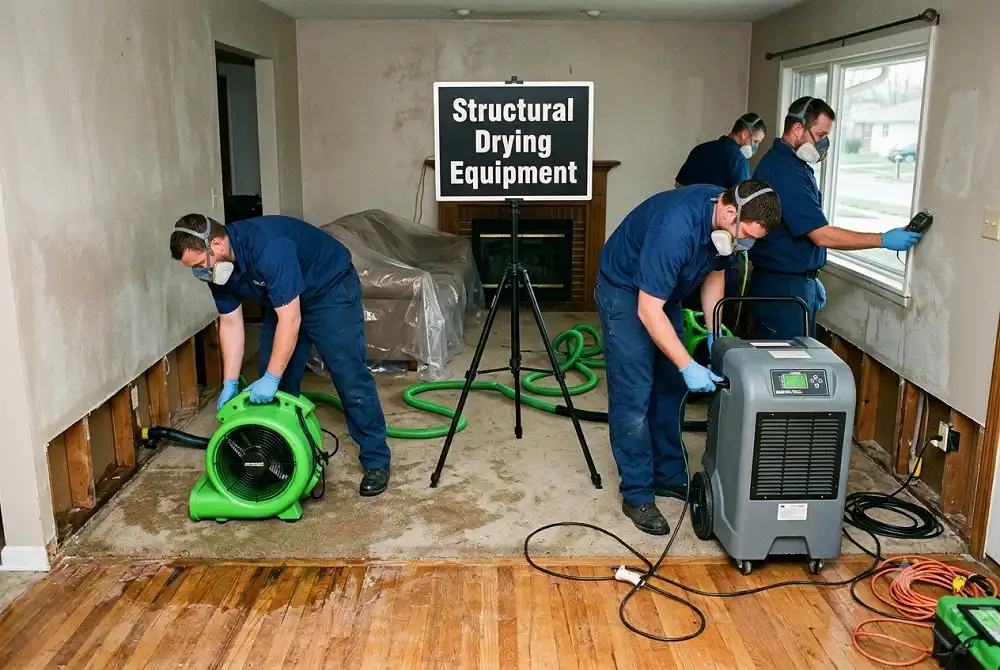
Structural drying removes the moisture you can’t see. Extraction pulls out liquid water. Drying pulls water vapor out of framing, subfloors, drywall, and concrete through controlled evaporation and dehumidification.
Equipment We Deploy and How We Size It
| Equipment | What It Does | Typical Sizing Metric |
|---|---|---|
| Air movers | Speed evaporation from wet surfaces | 1 per 10 to 16 linear feet of wet wall, plus 1 per 50 to 70 sq ft of wet floor |
| LGR dehumidifiers (low grain refrigerant) | Pull vapor from the air at low humidity | 70 to 170+ pints per day per unit, sized by room volume and class |
| Desiccant dehumidifiers | Dry dense materials in cool spaces | Used for hardwood, concrete, crawl spaces |
| HEPA air scrubbers | Capture spores and particles | Filter 99.97% of particles at 0.3 microns |
| Wall cavity drying systems | Inject air into closed walls | Used when drywall can be saved in place |
| Hardwood floor drying mats | Draw moisture up through floorboards | Panel systems placed over cupped boards |
| Moisture meters and thermal cameras | Locate hidden water | Readings logged daily until dry standard |
Expected Drying Timelines
| Situation | Typical Drying Time | Key Target |
|---|---|---|
| Class 1 bathroom leak | 1 to 2 days | Subfloor matches dry reference |
| Class 2 room flood | 3 to 5 days | Drywall and pad readings at dry standard |
| Class 3 overhead burst pipe | 3 to 5 days | Ceiling, insulation, wall cavities dry |
| Class 4 hardwood or concrete | 5 to 14 days | Wood moisture content within normal range |
| Flooded crawl space | 3 to 7 days | Joists and sill plates at or below about 15% MC |
What “Dry” Actually Means
Dry standard is the moisture level of the same material in an unaffected area of your home. We take a reference reading on day one. Then we track GPP (grains per pound, a measure of water vapor in the air) and material readings daily.
If you’ve lived through a humid Kansas summer, this moisture containment protocol makes complete sense. Outdoor air in July can carry heavy humidity, so we seal the drying area, called a drying chamber, and let dehumidifiers work on a controlled volume of air. Opening windows in August often slows drying down.
Every water damage Burlington job we run ends with a written drying log. Request that log before equipment leaves your home; your insurer and future buyers will both want it.
Mold Containment and Remediation Protocols
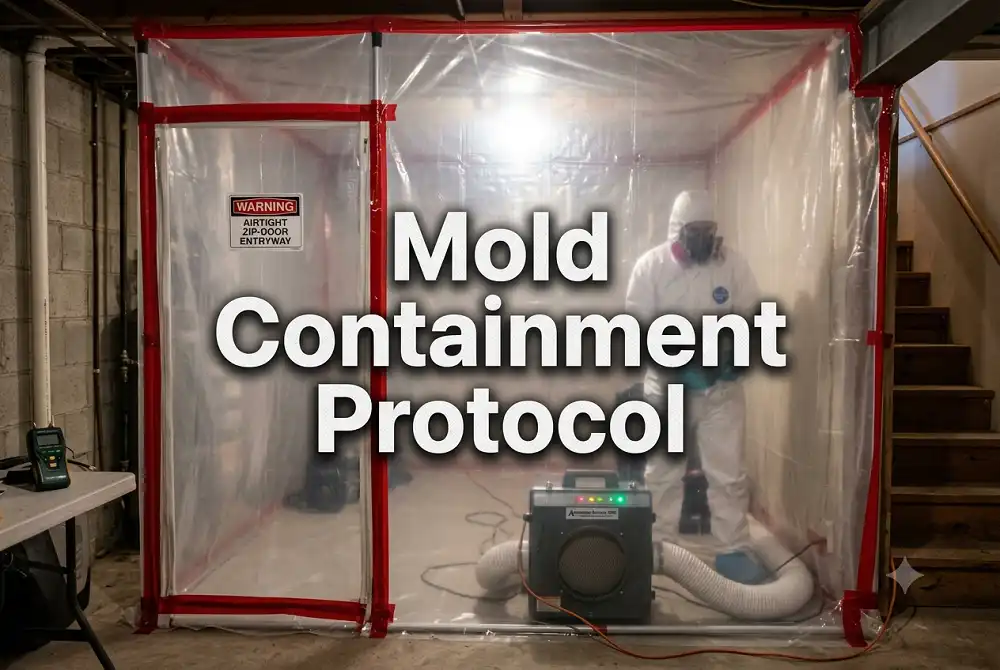
Mold control starts with moisture control. The U.S. Environmental Protection Agency’s mold guidance states this directly: the best way to control mold growth is to control moisture. Remove the water, and you remove mold’s fuel.
According to the CDC’s mold health guidance, you should clean up and dry your home within 24 to 48 hours after a flood. The CDC also recommends keeping indoor humidity no higher than 50% all day long. Mold grows on drywall, carpet, insulation, ceiling tiles, wood, and even dust.
Health Effects to Watch
The CDC lists reactions like stuffy nose, sore throat, coughing, wheezing, burning eyes, and skin rash. People with asthma, mold allergies, or weakened immune systems face higher risk. Keep vulnerable family members away from the work area until cleanup ends.
Our Mold Containment Protocol
- Fix the moisture source. Mold returns if the leak or seepage continues.
- Isolate the area. We seal rooms with 6-mil polyethylene sheeting and zip-door entries.
- Set negative air pressure. HEPA air scrubbers exhaust air so spores can’t drift into clean rooms.
- Shut down HVAC. We cover vents in the work zone to stop spore travel.
- Remove porous growth. Moldy drywall, insulation, and carpet get bagged and removed.
- Clean hard surfaces. We scrub framing and concrete, then HEPA vacuum all surfaces.
- Dry to standard. Dehumidifiers run until materials match reference readings.
- Verify before rebuild. Walls stay open until moisture readings confirm dry conditions.
Mold Mitigation Checklist for Homeowners
- Keep RH under 50% with a dehumidifier in basements and crawl spaces.
- Run bathroom and kitchen exhaust fans that vent outdoors.
- Remove soaked carpet that can’t be dried quickly.
- Never mix bleach with ammonia. The CDC warns it creates a poisonous gas.
- Use no more than 1 cup of bleach per 1 gallon of water on hard surfaces only.
- Skip home mold test kits. The CDC does not recommend mold testing; remove visible mold regardless of type.
When to Call a Professional
| Situation | DIY Reasonable? | Why |
|---|---|---|
| Under 10 sq ft on hard surfaces | Yes, with gloves, goggles, and an N-95 | EPA treats small areas as manageable |
| Over 10 sq ft | No | Larger growth needs containment |
| Mold inside walls or HVAC | No | Disturbing it spreads spores through the home |
| Mold after sewage or floodwater | No | Category 3 contamination adds health risk |
| Musty odor, no visible growth | No | Hidden growth needs thermal and moisture mapping |
On water damage Burlington jobs following spring floods, we often find mold behind finished basement walls that looked fine from the outside. Book a moisture inspection within a week of any flood, even when the walls look dry.
Materials Mitigation: Salvage vs. Replace Guidelines
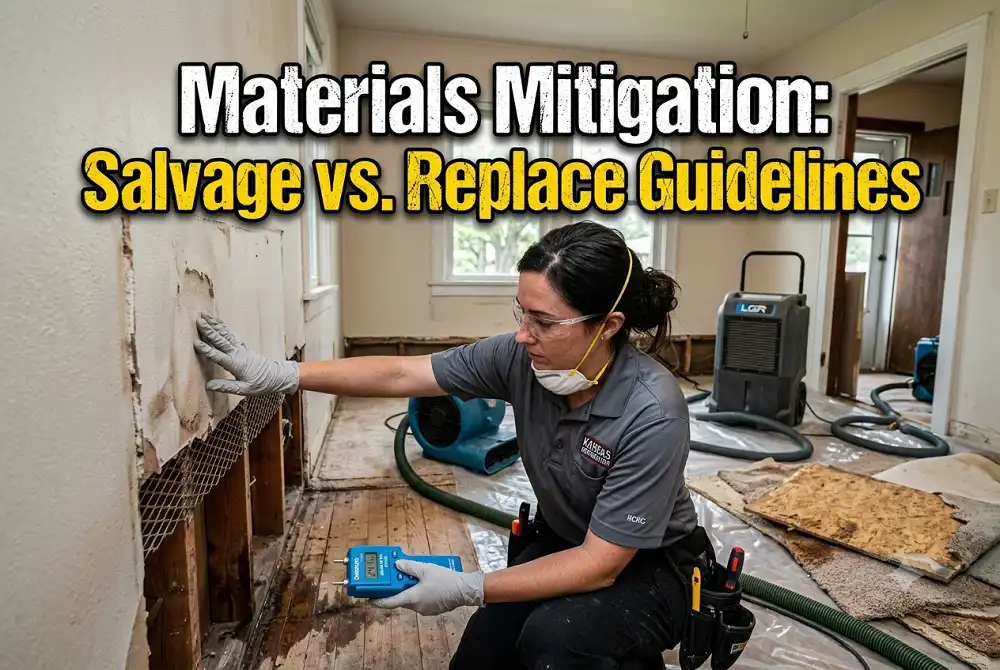
Some materials dry well, and others never recover. The deciding factors are water category, time wet, and material porosity. This table reflects how we make the call in the field.
| Material | Category 1 (Clean) | Category 3 (Black Water) | Field Notes |
|---|---|---|---|
| Drywall | Salvage if dried within 48 hours, no swelling | Replace; flood cut 12 to 24 inches above wick line | Check for soft spots and paper delamination |
| Fiberglass batt insulation | Usually replace | Replace | Loses R-value and holds moisture |
| Carpet pad | Sometimes salvage | Replace | Pad acts like a sponge |
| Carpet | Often salvage with extraction | Replace | Delamination means replace |
| Solid hardwood floors | Often salvage with floor drying mats | Usually replace | Minor cupping often flattens after drying |
| Laminate and engineered floors | Usually replace | Replace | Fiberboard core swells permanently |
| Particleboard and MDF cabinets | Replace if swollen | Replace | Swelling does not reverse |
| Solid wood furniture | Salvage | Clean, disinfect, evaluate | Dry slowly to prevent cracking |
| Upholstered furniture and mattresses | Professional cleaning | Discard | Can’t be fully sanitized |
| Concrete and block walls | Dry in place | Clean, disinfect, dry | Needs extended dehumidification |
| Plaster walls | Often salvage | Evaluate case by case | Common in Potwin and older Burlington homes |
| Documents and photos | Freeze them in sealed bags | Freeze, then professional restoration | Freezing buys time and stops mold |
Our crews in Potwin’s older homes regularly save plaster walls that a less experienced contractor would tear out. Saving original material saves money and history. Ask your restoration team to explain every removal decision before demolition starts.
Estimated Repair Costs in Burlington and Topeka, KS
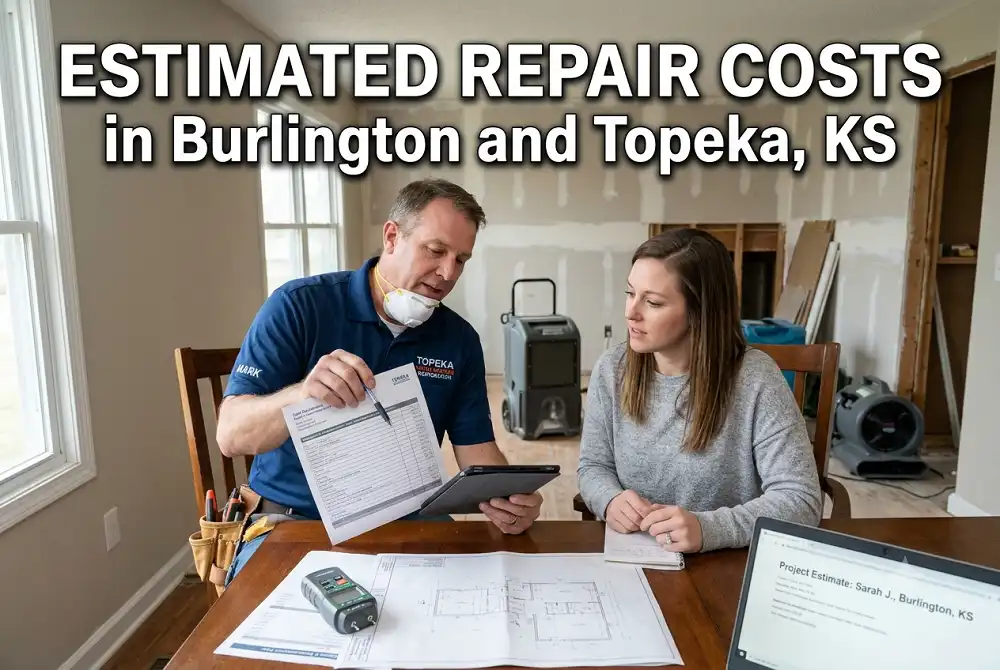
Repair cost depends on category, class, and response time. A Category 1 leak caught within hours can cost a fraction of the same leak found three days later. These are typical regional ranges for 2026 planning purposes.
| Service | Typical Cost Range | What Drives the Price |
|---|---|---|
| Water extraction, Category 1 | $3.75 to $7 per sq ft | Water depth, flooring type |
| Water extraction, Category 2 | $4.50 to $8 per sq ft | Added sanitizing |
| Sewage cleanup, Category 3 | $7 to $14 per sq ft | PPE, material removal, disinfection |
| Structural drying equipment | $1,000 to $3,500 per affected area | Number of units, days on site |
| Burst pipe restoration (full job) | $1,500 to $6,000 | Pipe location, ceiling and wall damage |
| Basement flood cleanup | $3,000 to $15,000+ | Finished vs. unfinished basement |
| Mold remediation, small area | $500 to $1,500 | Under 10 sq ft, minimal containment |
| Mold remediation, large area | $2,500 to $10,000+ | Containment size, HVAC involvement |
| Drywall replacement | $2.50 to $4.50 per sq ft | Texture, paint matching |
| Crawl space drying | $1,000 to $4,000 | Access, vapor barrier condition |
How to Lower Your Final Bill
- Call within the first hour. Fast extraction prevents category downgrades.
- Stop the source yourself. Every gallon you prevent is a gallon we don’t remove.
- Document before cleanup. Good photos speed up insurance approval.
- Approve drying before demolition. In-place drying often costs less than replacement.
At Topeka Water Damage Restoration, we give clear upfront quotes and free estimates with no hidden fees. For water damage Burlington property owners need priced fast, call (785) 331-0338 with a short description; we can often give a phone estimate in minutes.
Insurance Claim Steps That Protect Your Payout
Your policy type decides what gets paid. Most standard homeowners policies cover sudden and accidental water damage, like a burst pipe. They do not cover surface flooding or river overflow.
According to FEMA’s National Flood Insurance Program, most homeowners insurance does not cover flood damage. Flood coverage requires a separate policy for your building, contents, or both. FEMA also notes a typical 30-day waiting period before a new NFIP policy takes effect, so buy before spring rains, not during them.
Coverage Comparison
| Event | Standard Homeowners Policy | NFIP Flood Policy |
|---|---|---|
| Burst pipe (sudden) | Usually covered | Not applicable |
| Slow leak over months | Usually excluded | Not covered |
| Neosho River overflow | Excluded | Covered |
| Surface water through foundation | Usually excluded | Covered during a general flood |
| Sewer or drain backup | Requires an endorsement | Covered only when caused by flooding |
| Sump pump failure | Requires an endorsement | Limited |
| Basement contents | Varies | Limited coverage in basements |
| Mold | Often capped or excluded | Covered only if flood-caused and mitigated |
Claim Steps in Order
- Mitigate immediately. Policies require you to prevent further damage. Waiting can reduce your payout.
- Photograph and video every room. Include water lines on walls and serial numbers on appliances.
- Call your agent within 24 hours. Get your claim number in writing.
- Keep damaged material samples. Save a piece of carpet, pad, and drywall for the adjuster.
- Save every receipt. Hotel stays, meals, and supplies can fall under additional living expenses.
- Request moisture logs from your restorer. Our daily drying logs prove the work was necessary.
- Review the adjuster’s estimate line by line. Compare it against your restoration scope.
- Ask about appeal options. For NFIP disputes, FEMA lists an Office of the Flood Insurance Advocate.
When water damage Burlington homeowners claim comes from river flooding, the NFIP policy carries the claim, not your homeowners carrier. Check your declarations page today and confirm whether you hold sewer backup and sump pump endorsements.
Our Full Water Damage Restoration Service Catalog
Our services cover every stage from extraction to rebuild readiness. Each service below links to a detailed page in our full water damage restoration services portal.
| Service | When You Need It | What We Do |
|---|---|---|
| Water Extraction | Standing water on any floor | Truck-mounted and portable extraction |
| Water Removal | Water in walls, pad, or subfloor | Targeted removal and moisture mapping |
| Flood Cleanup | River or storm flooding | Category 3 cleanup, debris removal, disinfection |
| Basement Water Removal | Seepage or flooded basements | Pumping, extraction, slab drying |
| Sewage Cleanup | Drain or sewer backups | Full PPE, removal, antimicrobial treatment |
| Burst Pipe Water Damage | Frozen or failed supply lines | Extraction, ceiling and wall drying |
| Structural Drying | Any wet framing or subfloor | Air movers, LGR dehumidifiers, daily logs |
| Mold Remediation | Visible growth or musty odor | Containment, HEPA filtration, removal |
| Toilet Overflow Cleanup | Bathroom overflows | Category 2 or 3 cleanup and sanitizing |
| Sump Pump Failure Cleanup | Failed or overwhelmed pumps | Extraction, drying, pump failure documentation |
Additional Services for Burlington-Area Properties
- Crawl space drying for rural and older homes
- Hardwood floor drying with panel mat systems
- Ceiling water damage repair after roof or attic leaks
- Moisture detection with thermal imaging
- Water odor removal after drying
- Appliance leak cleanup for water heaters, washers, and refrigerators
- Commercial water damage for Burlington businesses
- Insurance claim assistance with full drying documentation
Bookmark the services page now so you have it before an emergency.
Local Water Damage Restoration in Burlington, KS 66839
Burlington gets the same equipment and standards as our Topeka jobs. Our crews serve ZIP code 66839 plus Lebo, Waverly, and Le Roy. Burlington sits about an hour south of Topeka along US-75, and we offer same-day priority for active leaks.
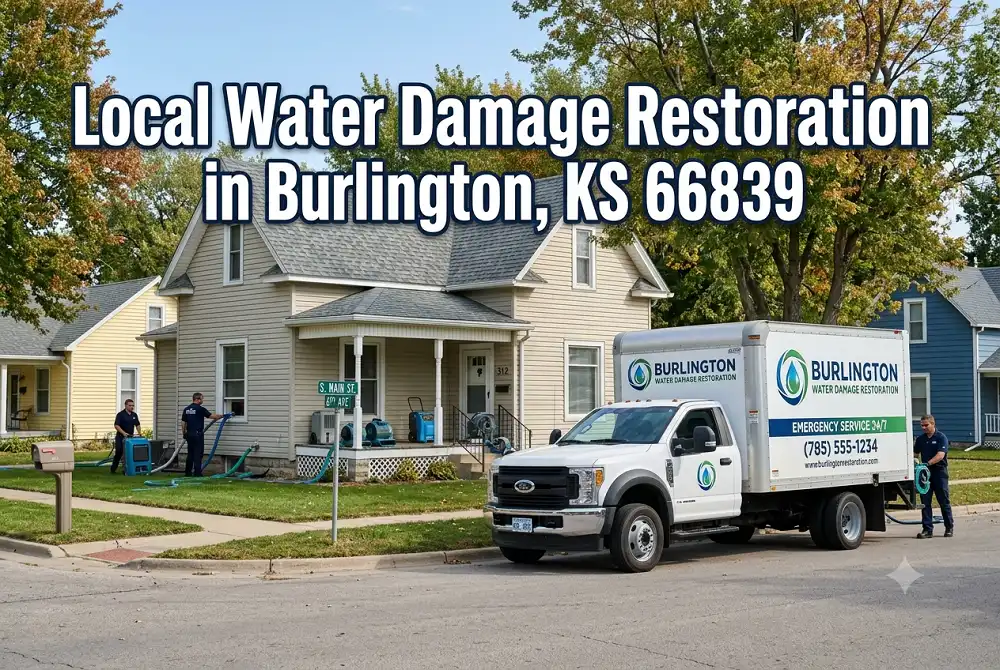
Visit our dedicated water damage Burlington service page for local details. It covers emergency water extraction, flood restoration, storm water damage, crawl space drying, and more.
What Burlington Customers Get
| Commitment | What It Means for You |
|---|---|
| 24/7 emergency line | Call (877) 679-6340 any time |
| Local Burlington line | Call (785) 331-0338 for scheduling and quotes |
| Free estimates | No hidden fees, upfront pricing |
| Written follow-up | Documentation after every visit |
| Lowest-impact methods first | We explain any stronger treatment before using it |
| Preventive visits | Quarterly checks available for high-risk properties |
The Topeka Experience Behind Your Burlington Job
We’ve spent 10+ years restoring 1,000+ properties across Topeka neighborhoods like Westboro, College Hill, and Potwin. Those homes taught us how older foundations, plaster walls, and cast-iron drains fail. Burlington’s older housing stock behaves the same way. Experience on one street transfers to the next town.
Save (785) 331-0338 in your phone today so the number is ready when you need it.
FAQs
How fast does mold grow after a leak?
Mold can begin growing within 24 to 48 hours on wet materials. The CDC recommends full cleanup and drying inside that window. Visible growth often appears within days.
Can I stay in my home during drying?
Most families stay home during Category 1 drying. Category 3 sewage or flood losses usually require you to leave the affected area. Equipment noise runs around the clock for several days.
Does homeowners insurance cover a sump pump failure?
Only if you carry a sump pump or water backup endorsement. Without it, most standard policies exclude the damage. Check your declarations page now.
How do I know the walls are actually dry?
Ask for daily moisture readings compared against a dry reference point. Touch and appearance are not reliable. Thermal imaging confirms hidden moisture is gone.
Your Next Move After a Burlington Water Loss
Speed, category, and documentation decide every water loss outcome. Stop the source, protect your family from contaminated water, and start professional extraction within the first hour. Dry to a measured standard, not to “looks fine.”
Mold prevention depends on hitting the 24 to 48 hour drying window and holding humidity under 50%. Salvage decisions depend on water category and time. Insurance outcomes depend on the right policy and clean records.
At Topeka Water Damage Restoration, we bring the same 24/7 readiness, transparent pricing, and jargon-free advice to Burlington that Topeka homeowners count on. Call (877) 679-6340 for emergencies or (785) 331-0338 for Burlington scheduling, and our crew will start your moisture map the day we arrive.