A house fire leaves two disasters behind: burned materials and thousands of gallons of firefighting water. Many homeowners focus on the char. The bigger hidden threat is the water soaking your subfloor, drywall, and insulation. Without fast drying, that water starts feeding mold growth within 24 to 48 hours. Effective fire damage restoration Shawnee property owners can trust starts with handling the water first, because the fire is out, but the damage is still spreading.
At Topeka Water Damage Restoration, our crews answer 24/7 emergency calls across Topeka and Shawnee County. We focus on the moisture side of fire recovery: water extraction, structural drying, and mold remediation. This article walks you through every stage, with tables, checklists, and real local costs.
🔑 Key Point
- Call for water extraction within 24 hours. Firefighting water is often contaminated with soot and chemicals, and mold can start in 24 to 48 hours.
- Document everything before you clean. Photos, videos, and a room-by-room inventory protect your insurance claim value.
- Porous materials usually get replaced, not cleaned. Wet insulation, carpet pad, and soot-soaked drywall rarely pass a salvage test.
How Mold Remediation Shawnee Protects Your Topeka Home From Structural Mold Damage
Emergency Fire Damage Response: What to Do in the First 48 Hours
The first 48 hours decide the size of your repair bill. Soot turns acidic, standing water wicks upward, and humidity climbs fast in a closed, damaged house. Every hour you wait adds cost. Professional fire damage restoration Shawnee response focuses on stabilizing the structure and stopping secondary damage before any rebuild talk begins.
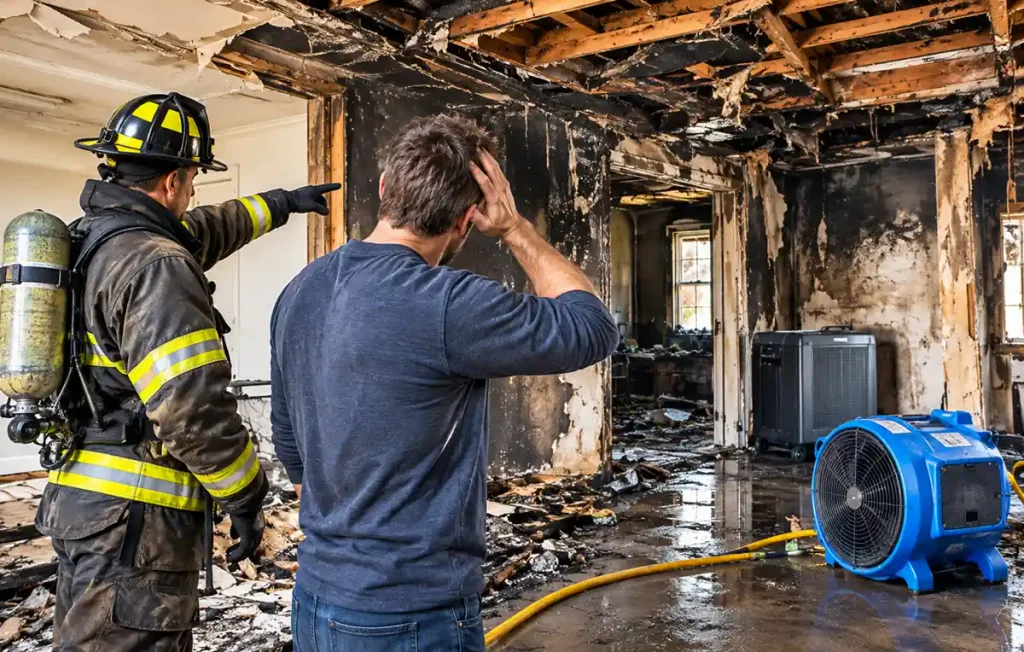
Steps to Stop Damage From Spreading
- Get clearance from the fire department. Never re-enter until officials say the structure is safe.
- Shut off utilities. Confirm that power, gas, and water are off at the main.
- Photograph every room. Capture ceilings, floors, and contents before anything moves.
- Call your insurance carrier. Get a claim number the same day.
- Call for emergency water extraction. Our team aims to arrive within 60 minutes.
- Board up and tarp openings. Broken windows and roof holes let in rain and pests.
- Remove salvageable valuables. Take documents, medications, and photos to a dry location.
- Leave wet electronics alone. Do not power on anything that got wet or smoked.
Fire Damage Severity Categories
Fire damage severity (how deep the heat, smoke, and water reached) shapes the entire recovery plan.
| Severity Level | What You See | Water Involvement | Typical Timeline |
|---|---|---|---|
| Minor | Smoke film on walls, small burn area, light odor | Little to none | 2 to 5 days |
| Moderate | Charred room, soot in multiple rooms, HVAC contamination | Hose water in 1 to 3 rooms | 1 to 4 weeks |
| Major | Structural burn, roof damage, whole-house soot | Heavy flooding, basement water | 1 to 6 months |
| Total Loss | Collapsed framing, unsafe structure | Extensive saturation | Demolition and rebuild |
On recent emergency service calls in College Hill, we found moderate fires that left more water damage than burn damage. Two rooms burned. Five rooms flooded.
Your next step: write down the time firefighters left, so your restoration crew knows how long water has been sitting.
Smoke and Soot Damage: The Residue That Keeps Doing Harm
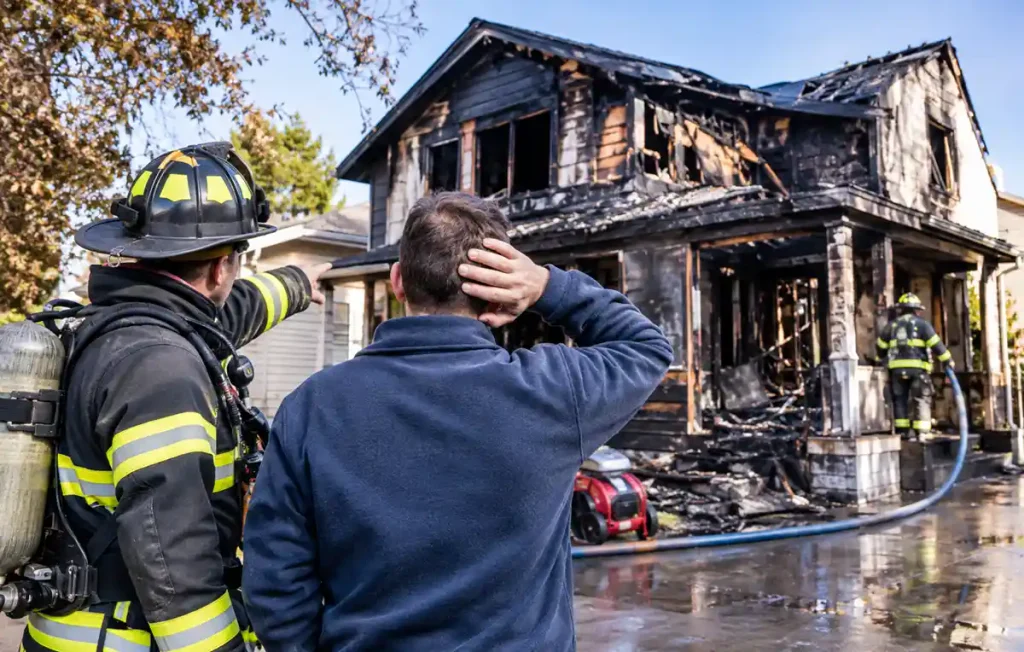
Smoke and soot damage spreads far beyond the burn area. Soot (fine carbon particles left by incomplete burning) travels through HVAC ducts, wall cavities, and outlet openings. It settles on every surface. Left alone, it etches glass, discolors grout, and corrodes metal fixtures within days.
Smoke particles are also an air quality problem. According to the EPA’s indoor air quality guidance, fine particulate matter (PM2.5) carries the greatest health concern indoors. The EPA also warns that ozone generators sold as air cleaners are not approved by any federal agency for occupied spaces. That matters, because some contractors push ozone treatments while families still live in the home.
Types of Smoke Residue
| Residue Type | Source | Texture | Cleaning Difficulty |
|---|---|---|---|
| Dry smoke | Paper, wood, fast hot fires | Powdery, dry | Moderate |
| Wet smoke | Plastics, rubber, slow smoldering fires | Sticky, smeary, strong odor | High |
| Protein residue | Kitchen fires, burned food | Nearly invisible, yellow film | High (odor heavy) |
| Fuel oil soot | Furnace puff-backs | Dense, black, oily | Very high |
Smoke Damage Timeline
| Time After Fire | What Happens |
|---|---|
| Minutes to hours | Plastics yellow, porous surfaces discolor |
| Hours to 2 days | Walls stain, metal tarnishes, odor sets in fabric |
| 2 days to 1 week | Wood finishes need refinishing, metal corrodes |
| Weeks | Permanent etching, deep odor in framing |
Proper fire damage restoration Shawnee homeowners can count on starts with HEPA vacuuming (high-efficiency particulate air filtration), then dry sponge cleaning, then wet cleaning. Wiping soot with a wet rag first smears it deeper into paint. That one mistake can turn a cleaning job into a repaint.
Your next step: replace your furnace filter with a MERV 13 rated filter once the HVAC system is cleared to run, as the EPA recommends for capturing fine particles.
Structural Assessment: Checking What Fire and Water Weakened
A structural assessment confirms whether your home is safe to enter and repair. Heat weakens framing, water swells subfloors, and soaked drywall loses strength. The combination is dangerous. A ceiling that looks fine can hold hundreds of pounds of trapped water above it.
Our restoration crews frequently encounter this in historic Westboro and Potwin homes. Older plaster and lath walls hold water longer than modern drywall. Balloon framing (wall studs that run continuously from foundation to roof) lets smoke and moisture travel between floors with no fire blocking.
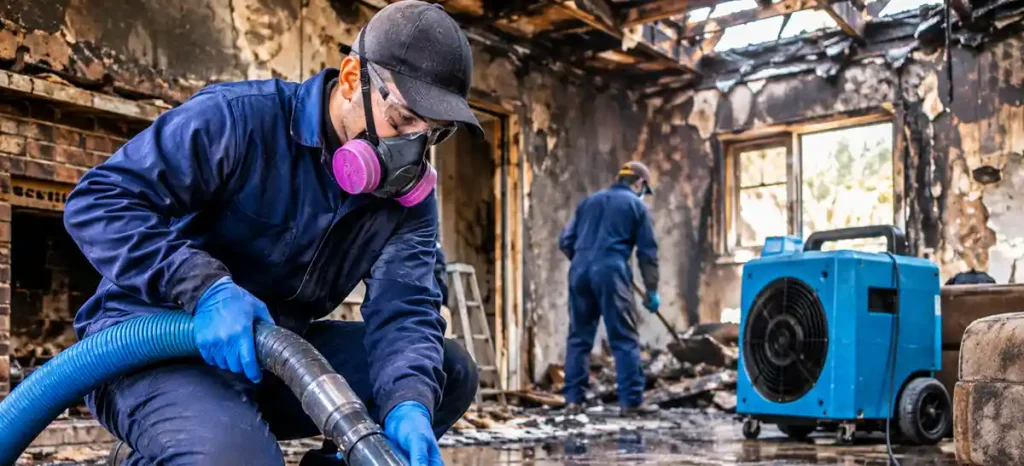
What We Check During a Structural Assessment
- Ceiling sag: a sign of trapped water above drywall
- Floor deflection: soft spots point to swollen subflooring
- Moisture readings: we use pin and pinless moisture meters on framing and walls
- Thermal imaging: infrared cameras reveal hidden wet zones behind walls
- Char depth: we probe burned framing to measure remaining solid wood
- Foundation and basement: standing water often collects below grade
- Electrical exposure: wet wiring and panels get flagged for a licensed electrician
Structural Red Flags
| Warning Sign | Likely Cause | Action |
|---|---|---|
| Bowed or bulging ceiling | Trapped firefighting water | Do not walk under it. Controlled drainage needed |
| Spongy floors | Saturated OSB or plywood subfloor | Moisture mapping, likely replacement |
| Cracked plaster | Heat expansion plus water weight | Engineer review in older homes |
| Musty smell after 3 days | Early mold growth | Immediate mold inspection |
| Rust on joist hangers | Corrosive soot plus moisture | Hardware replacement |
Every fire damage restoration Shawnee project should begin with moisture mapping (a documented record of moisture readings across the structure). That map guides drying and supports your claim.
Your next step: ask any contractor for a written moisture map before demolition starts.
Water Damage From Firefighting Efforts: The Flood After the Fire
Firefighting water causes more damage than most homeowners expect. A single fire hose can flow hundreds of gallons per minute. That water carries soot, ash, and burned chemical residue into floors, walls, and basements. In split-level homes in Highland Park and Sherwood, we regularly find water pooled in the lowest level days after the fire.
Water Damage Category Comparison
The IICRC standards, including the S500 water damage standard, classify water by contamination level. Firefighting runoff is often treated as Category 2 or Category 3 because of soot and chemical contamination.
| Category | Description | Fire Scene Example | Required Response |
|---|---|---|---|
| Category 1 (Clean) | Sanitary source, low risk | Burst supply line, early stage | Extract, dry, monitor |
| Category 2 (Gray) | Contaminated, may cause illness | Hose water mixed with ash and soot | Extract, clean, antimicrobial, dry |
| Category 3 (Black) | Grossly unsanitary | Water mixed with sewage, chemicals, or burned materials after 48+ hours | Remove porous materials, sanitize, dry, PPE required |
Water also gets worse over time. Category 1 water becomes Category 2 after roughly 48 hours. Category 2 becomes Category 3 if left sitting in a warm structure.
Structural Drying Timelines and Equipment Metrics
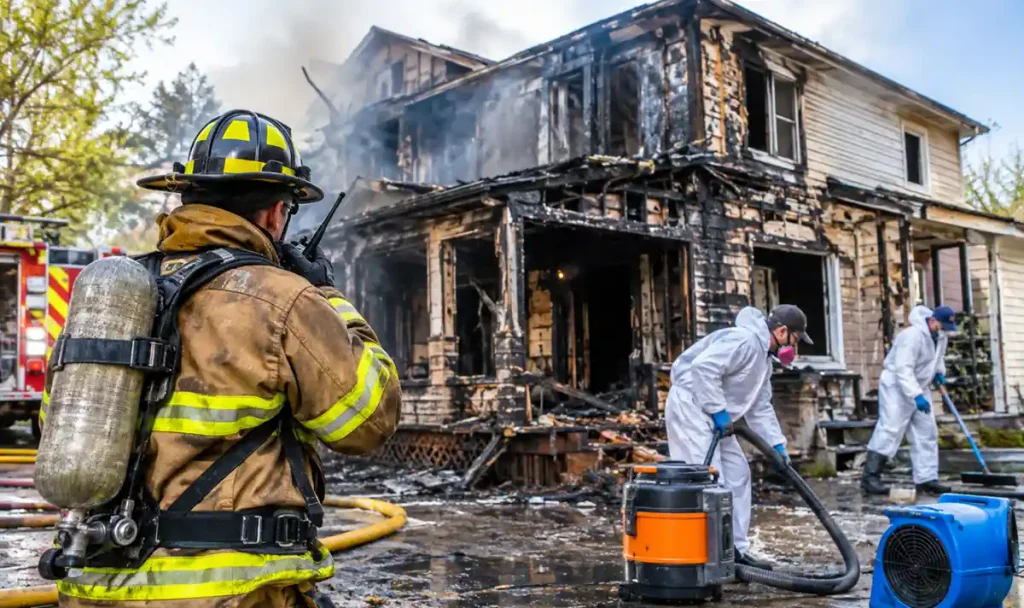
Structural drying (removing moisture from building materials, not just surfaces) uses calculated equipment placement.
| Material | Typical Drying Time | Target Moisture | Equipment Used |
|---|---|---|---|
| Drywall | 2 to 4 days | Under 1% (meter scale) or matched to dry reference | Air movers, LGR dehumidifiers |
| Wood framing | 3 to 7 days | 15% or lower | Air movers, dehumidifiers, heat drying |
| Hardwood floors | 5 to 14 days | Within 2 to 4% of dry reference | Floor drying mats, dehumidifiers |
| Concrete slab/basement | 7 to 21 days | Matched to dry reference | Desiccant dehumidifiers, air movers |
| Plaster and lath | 5 to 10 days | Matched to dry reference | Injection drying, air movers |
| Equipment | Placement Guideline | Purpose |
|---|---|---|
| Air movers | About 1 per 10 to 16 linear feet of wet wall | Pull moisture off surfaces |
| LGR dehumidifiers | Sized by cubic feet and water class | Remove moisture from air |
| Desiccant dehumidifiers | Cold basements, dense materials | Dry in low temperatures |
| HEPA air scrubbers | 1 per 500 to 1,000 sq ft affected | Capture soot and spores |
| Moisture meters | Daily readings | Confirm drying progress |
LGR stands for low-grain refrigerant, a dehumidifier type that pulls more water from air at lower humidity levels. Fast, verified drying is the core of fire damage restoration Shawnee residents need after a hose-down.
Pro and Con: Extraction Approaches
- Truck-mounted extraction
- Pro: highest suction power, fastest for large volumes
- Con: needs hose access from the driveway
- Portable extraction units
- Pro: reaches upper floors and tight spaces
- Con: slower on heavy flooding
- Submersible pumps
- Pro: best for deep basement water
- Con: leaves surface water that still needs extraction
Your next step: ask for daily drying logs so you can see moisture numbers fall each day.
Mold Risk After Fire Suppression: Why Wet Smoke Damage Turns Into Growth
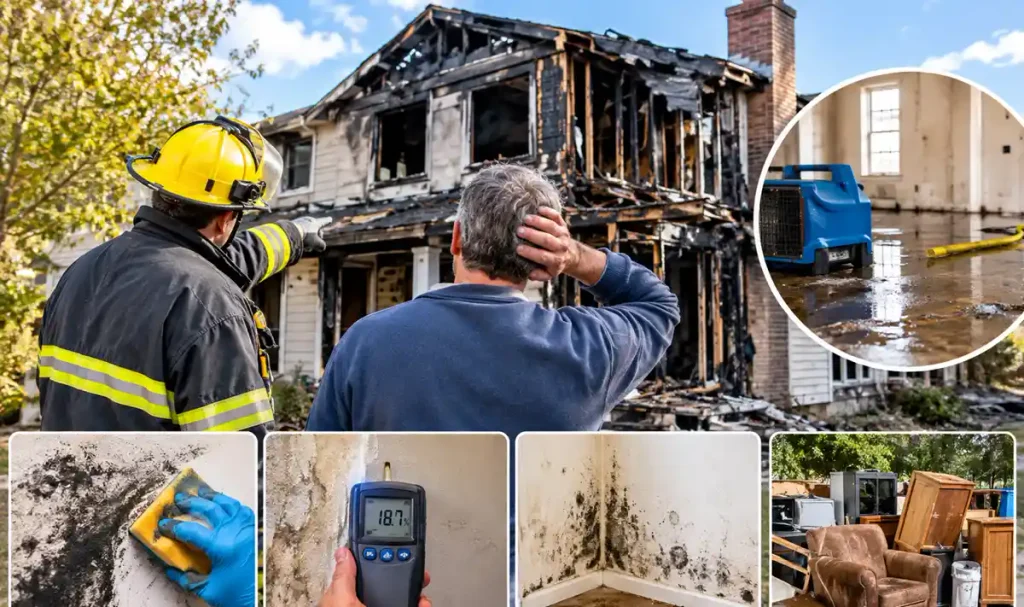
Mold risk after fire suppression is real and fast. Firefighting water, damaged roofs, and disabled HVAC systems create a warm, humid, enclosed space. Burned organic material even gives mold extra food. If you’ve lived through a humid Topeka summer, you know how quickly a closed-up house starts to smell musty.
The EPA states that air cleaners and filters do not solve mold problems. Mold comes from a moisture source. You have to remove the moisture and clean the growth. Running an air purifier in a soaked house only treats the symptom.
Mold Risk Factors After a Fire
| Factor | Risk Level | Why It Matters |
|---|---|---|
| Water sitting 48+ hours | High | Mold colonies form in 24 to 48 hours |
| Summer heat and humidity | High | Topeka summers often push indoor humidity above 60% |
| Roof or window openings | Medium to High | Rain adds new moisture |
| HVAC shut down | Medium | No air movement or dehumidification |
| Fall and winter fires | Medium | Cold slows growth but traps moisture in framing |
Mold Mitigation Checklist
- Extract standing water within 24 hours.
- Set up containment with poly sheeting and negative air pressure around affected rooms.
- Remove wet porous materials like carpet pad and insulation.
- Apply an EPA-registered antimicrobial to exposed framing.
- Run HEPA air scrubbers during removal work.
- Dry to verified targets with moisture meters.
- Inspect hidden cavities behind baseboards and cabinets.
- Verify clearance before closing walls.
Mold prevention belongs in every fire damage restoration Shawnee plan. The IICRC S520 mold remediation standard sets the containment and removal procedures our technicians follow.
Your next step: check a hygrometer in the affected area, and call us if indoor humidity stays above 60%.
How Sewage Cleanup Overland Park Crews Protect Your Home From Structural Mold Damage
Materials Salvage vs. Replace: What Can Be Saved After Fire and Water
Salvage decisions depend on three factors: porosity, contamination level, and time wet. Hard, non-porous items usually clean well. Porous items soaked in Category 3 water almost never do. Saving the wrong item costs more than replacing it once mold returns.
Salvage vs. Replace Guidelines
| Material | Usually Salvage | Usually Replace |
|---|---|---|
| Drywall | Light smoke film, dry | Wet over 48 hours, soot-soaked, Category 3 |
| Insulation | Rarely | Wet, smoke-saturated, burned |
| Carpet | Category 1 water, cleaned fast | Category 2/3 water, heavy soot |
| Carpet pad | Almost never | Any contaminated water |
| Hardwood floors | Dried fast, no cupping | Severe cupping, buckling, charring |
| Solid wood furniture | Cleaned and refinished | Deep char, warped joints |
| Particleboard furniture | Rarely | Any significant water contact |
| Upholstery and mattresses | Light smoke, professional cleaning | Water-soaked, heavy odor |
| Clothing and fabrics | Most smoke odor can be laundered or dry cleaned | Burned or Category 3 soaked |
| Electronics | Professional evaluation | Water-damaged or heat-warped |
| Metal fixtures | Cleaned within 1 to 3 days | Pitted or corroded |
| Food and medications | Never | Any exposure to heat, smoke, or water |
Our crews often see this in NOTO Arts District buildings, where older masonry and wood floors can be dried and saved. Modern laminate and MDF trim usually swell and must be replaced.
Getting salvage calls right keeps fire damage restoration Shawnee costs under control and protects your insurance payout.
Your next step: photograph every discarded item with a label showing its room and estimated value.
Estimated Repair Costs in Topeka and Shawnee County
Fire and water repair costs in Topeka depend on damage size, water category, and material replacement. The figures below are typical local ranges. Every home is different, so a written, itemized estimate always comes first.
Estimated Repair Costs in Topeka, KS
| Service | Typical Cost Range | Key Cost Drivers |
|---|---|---|
| Clean water extraction and drying (Category 1) | $1,500 to $5,000 | Square footage, drying days |
| Gray water cleanup (Category 2) | $3,000 to $8,000 | Antimicrobial treatment, material removal |
| Black water or major flooding (Category 3) | $8,000 and up | PPE, demolition, sanitation |
| Firefighting water extraction | $2,000 to $10,000 | Volume, floors affected, basement water |
| Smoke and soot cleaning | $1,000 to $10,000+ | Residue type, rooms affected |
| Mold remediation | $1,500 to $6,000+ | Containment size, hidden growth |
| Structural drying equipment | $100 to $250 per unit, per day (typical) | Number of units, duration |
| Minor fire restoration total | $3,000 to $15,000 | Single room, light water |
| Moderate fire restoration total | $15,000 to $50,000 | Multiple rooms, hose water, HVAC |
| Major fire restoration total | $50,000 to $150,000+ | Structural repair, full rebuild areas |
What Raises or Lowers Your Cost
| Raises Cost | Lowers Cost |
|---|---|
| Waiting more than 48 hours | Same-day extraction |
| Category 3 contamination | Clean water source |
| Mold growth present | Fast drying with documentation |
| Older plaster walls and balloon framing | Modern drywall construction |
| Finished basements | Unfinished basements |
Homes in Tecumseh, Auburn, and Berryton sometimes see slightly higher travel and equipment staging costs. Rural properties with well systems and septic tanks may also need extra checks. Transparent pricing is part of honest fire damage restoration Shawnee work, and we explain every line item before work begins.
Your next step: request a free estimate and compare it line by line against your insurance adjuster’s scope.
Water Damage Burlington: How Rapid Drying Protects Your Kansas Home From Mold and Structural Failure
Insurance Claim Steps for Fire and Water Damage
A strong insurance claim starts on day one. Most Kansas homeowners policies cover sudden fire damage and the water used to put it out. Claims get reduced when documentation is weak or when secondary damage like mold grows from delay. Insurers expect you to take reasonable steps to prevent further damage.
Fire Damage Insurance Claim Steps
- Report the loss immediately. Call your carrier and write down your claim number.
- Request the fire department report. Your adjuster will ask for it.
- Document all damage. Take wide shots and close-ups of every room.
- Mitigate further damage. Hire emergency water extraction and board-up services.
- Keep every receipt. Hotels, meals, and supplies may fall under Additional Living Expenses (ALE).
- Build a contents inventory. List item, age, purchase price, and replacement cost.
- Meet the adjuster on site. Have your restoration contractor present if possible.
- Review the scope of loss. Compare it against your contractor’s moisture map and estimate.
- Hold off on signing final releases. Wait until all hidden damage is found.
What Insurance Typically Covers
| Damage Type | Homeowners Policy | Flood Policy (NFIP) |
|---|---|---|
| Fire and smoke damage | Usually covered | Not covered |
| Firefighting water damage | Usually covered | Not covered |
| Mold from firefighting water | Often covered if promptly mitigated | Not covered |
| Mold from delayed response | Often denied | Not covered |
| River or creek flooding | Not covered | Covered |
| Sewer backup | Requires endorsement | Limited |
Fire claims and flood claims are separate. Homes near Shunga Creek and the Kansas River may need flood coverage for spring flash floods. The FEMA National Flood Insurance Program explains what flood policies cover and how to buy one.
A documented fire damage restoration Shawnee process gives your adjuster clean evidence: moisture logs, photos, and itemized invoices.
Your next step: create a shared folder today for photos, receipts, and your claim number.
Topeka Water Damage Restoration Services for Fire and Water Recovery
Our services handle the water and moisture side of fire recovery. That is often the part that causes the most lasting damage. We respond 24/7, aim to arrive within 60 minutes, and give clear advice without jargon. Our crews bring advanced extraction and drying equipment to every job in Topeka and Shawnee County.
Our Core Service Catalog
| Service | What It Solves | When You Need It After a Fire |
|---|---|---|
| Water Extraction | Pulls standing water from floors and carpets | Immediately after firefighters leave |
| Water Removal | Clears large volumes from rooms and structures | Heavy hose water across multiple rooms |
| Flood Cleanup | Cleans and sanitizes flooded areas | Contaminated runoff with ash and soot |
| Basement Water Removal | Pumps and dries below-grade spaces | Water drained to the lowest level |
| Structural Drying | Dries framing, subfloors, and wall cavities | Every fire with water involvement |
| Mold Remediation | Contains and removes mold growth | Musty odors or visible growth after 48 hours |
| Sewage Cleanup | Removes Category 3 black water safely | Damaged drain lines or backups |
| Burst Pipe Water Damage | Repairs damage from failed supply lines | Heat-damaged or frozen pipes in a vacant home |
| Sump Pump Failure Cleanup | Handles basement flooding from pump failure | Power shutoff stops your sump pump |
| Toilet Overflow Cleanup | Sanitizes contaminated bathroom water | Plumbing damaged during the fire |
Why Shawnee County Property Owners Call Us
- 24/7 emergency response: we answer nights, weekends, and holidays
- Local expertise: we know Topeka’s freezing winters, humid summers, and spring flash floods
- Advanced equipment: LGR dehumidifiers, thermal cameras, and HEPA air scrubbers
- Transparent process: clear communication and no hidden steps
A fire often triggers a chain of failures. Power gets cut, so the sump pump stops. The house sits vacant in January, so pipes freeze and burst. We see this pattern every winter, and our fire damage restoration Shawnee support covers each of those follow-up problems under one team.
Your next step: save our number, (877) 679-6340, in your phone today.
Asked Questions
How soon should water be removed after a house fire?
Water should be removed within 24 hours. Mold can begin growing in 24 to 48 hours, and contaminated water gets worse with time. Call as soon as the fire department clears entry.
Is firefighting water considered clean water?
No. Firefighting water picks up soot, ash, and chemical residue. It is usually handled as Category 2 or Category 3 water under IICRC guidelines.
Can I clean soot myself?
You can remove light dust with a HEPA vacuum. Avoid wet wiping first, because it smears soot into surfaces. Heavy or oily soot needs professional cleaning.
Will my insurance pay for mold after a fire?
Often yes, if you mitigated quickly. Insurers frequently deny mold claims tied to delayed response. Fast extraction and drying logs protect your coverage.
Should I run my HVAC system after a fire?
Not until it is inspected. Running a contaminated system spreads soot through every room. Once cleared, install a MERV 13 filter or the highest rating your system allows.
Act Within the First 24 Hours
Fire recovery is a race against moisture. The flames do their damage in minutes. The water left behind keeps damaging your home for days, then weeks, if nobody dries it. Fast extraction, verified structural drying, and mold prevention protect your structure, your health, and your insurance claim.
Start with three moves: document everything, report the claim, and get the water out. Then hold every contractor to written moisture maps and itemized pricing. Our crews serve Westboro, College Hill, Potwin, NOTO, Highland Park, Sherwood, Tecumseh, Auburn, Berryton, and all of Shawnee County around the clock.
Call (877) 679-6340 or request your free estimate to get a crew on site within the hour.