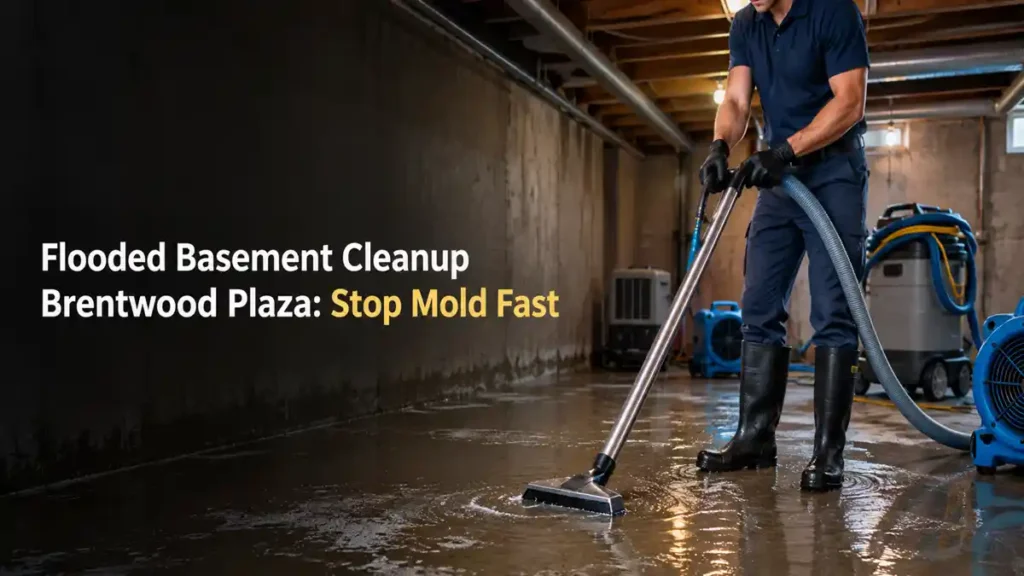
Standing water starts damaging a basement within the first hour. Drywall wicks moisture upward, carpet pad soaks through, and wood framing absorbs water it will hold for weeks. Fast flooded basement cleanup Brentwood Plaza property owners can count on is the difference between a three-day drying job and a full gut renovation. The clock starts the moment water touches your floor, not when you call for help.
So what does that mean for your Topeka home? Mold can begin growing in 24 to 48 hours. Insurance adjusters look closely at how fast you acted. And every hour of delay raises the final repair bill.
Key Takeaways
- Extract water within 24 hours and start structural drying within 48 hours to keep mold growth and drywall replacement off your repair bill.
- Identify the water category first. Clean pipe water (Category 1) and sewage backup (Category 3) require completely different cleanup protocols and safety gear.
- Document everything before cleanup begins. Photos, videos, and moisture readings form the backbone of a successful insurance claim.
Water Damage Burlington: How Rapid Drying Protects Your Kansas Home From Mold and Structural Failure
Why Brentwood Plaza Area Basements Flood
Brentwood Plaza area basements flood because of groundwater pressure, aging plumbing, and Kansas weather extremes. Topeka sees all three in a single year.
We see three seasonal patterns on our calls:
| Season | Primary Cause | What We Find On Site |
|---|---|---|
| Winter (Dec to Feb) | Frozen and burst pipes | Supply lines split along exterior walls and crawlspace runs |
| Spring (Mar to Jun) | Flash floods and heavy rain | Seepage through foundation cracks, window wells, and floor drains |
| Summer (Jul to Sep) | Humidity and sump overload | Sump pump failure during storms, condensation, early mold |
| Year-round | Appliance and fixture failure | Water heater leaks, washer hoses, toilet overflows |
Spring storms push runoff toward Shunga Creek and the Kansas River drainage areas. Saturated soil then builds hydrostatic pressure (the force of groundwater pushing against foundation walls). Water finds the weakest point. Usually that point is the joint where your wall meets the floor slab.
Our restoration crews frequently encounter this in historic Westboro basements. Older fieldstone and block foundations lack modern waterproofing. The same pattern shows up in Potwin’s century-old homes and in Highland Park properties with original clay sewer laterals.
Neighborhoods we serve for flooded basement cleanup Brentwood Plaza residents and nearby areas include:
- Westboro, College Hill, Potwin: older foundations, frequent seepage
- NOTO Arts District: mixed-use buildings with shared drain lines
- Highland Park, Sherwood: sump-dependent basements, storm surges
- Tecumseh, Auburn, Berryton: rural wells, septic, and sump systems
Your first move is a call for professional basement water removal the moment you see standing water.
Water Damage Category Comparison: Clean, Grey, and Black Water
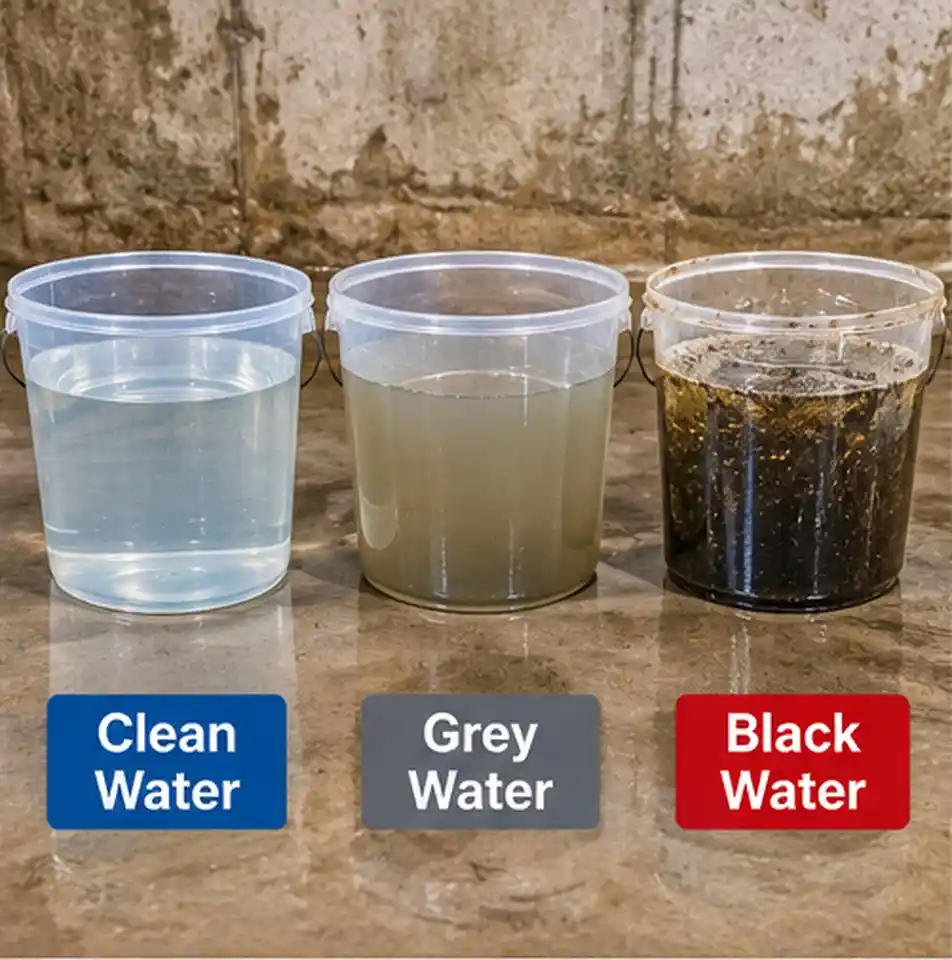
Water category determines cleanup method, safety gear, and what you can save. The IICRC S500 standard defines three categories based on contamination level.
Category matters more than water depth. One inch of sewage is more dangerous than six inches of clean supply-line water. That single fact drives every decision in flooded basement cleanup Brentwood Plaza homeowners face.
| Factor | Category 1: Clean Water | Category 2: Grey Water | Category 3: Black Water |
|---|---|---|---|
| Common Sources | Burst supply pipe, water heater, rain through window | Washing machine, dishwasher, toilet overflow (urine only), sump failure | Sewage backup, river or creek flooding, toilet with feces |
| Contamination | Minimal at first | Significant chemical or biological load | Grossly contaminated, pathogens present |
| Health Risk | Low | Moderate: can cause illness | High: bacteria, viruses, parasites |
| Time to Degrade | Becomes Cat 2 in 24 to 48 hours | Becomes Cat 3 in 48 hours | Already worst case |
| PPE Required | Gloves, boots | Gloves, boots, N95 respirator | Full PPE: respirator, Tyvek suit, eye protection |
| Carpet and Pad | Often salvageable | Pad replaced, carpet maybe | Both replaced |
| Drywall | Dry in place if caught early | Cut and replace affected areas | Remove at least 2 feet above waterline |
| Antimicrobial Treatment | Optional | Required | Required, plus sanitizing |
Water Damage Class: How Much Is Wet
Category measures contamination. Class measures how much water evaporation the job requires. We use both to size the drying setup.
| Class | Description | Typical Basement Example |
|---|---|---|
| Class 1 | Small area, low-porosity materials | Water heater leak on bare concrete |
| Class 2 | Whole room, wicking up to 24 inches on walls | Carpeted rec room with wet drywall |
| Class 3 | Saturated walls, ceilings, insulation | Overhead pipe burst onto finished space |
| Class 4 | Bound water in dense materials | Hardwood, plaster, brick, concrete |
Floodwater from outside or any drain backup always gets treated as Category 3. If your basement has a sewage smell, stay out and call for professional sewage cleanup before touching anything.
Steps to Stop Water Spreading
Stopping water spread protects unaffected rooms, electrical systems, and your claim value. These steps take about 15 minutes.
On recent emergency service calls in College Hill, homeowners who completed steps 1 through 4 before we arrived cut their drying time by a full day. Fast action works. Every action below is safe for a homeowner unless the water is Category 3.
- Shut off power to the basement. Use the main breaker if the panel sits in standing water, and never step into water to reach it.
- Close the main water valve. Find it near the meter, usually on the front basement wall.
- Identify the source. Check supply lines, the water heater, sump pit, floor drain, and window wells.
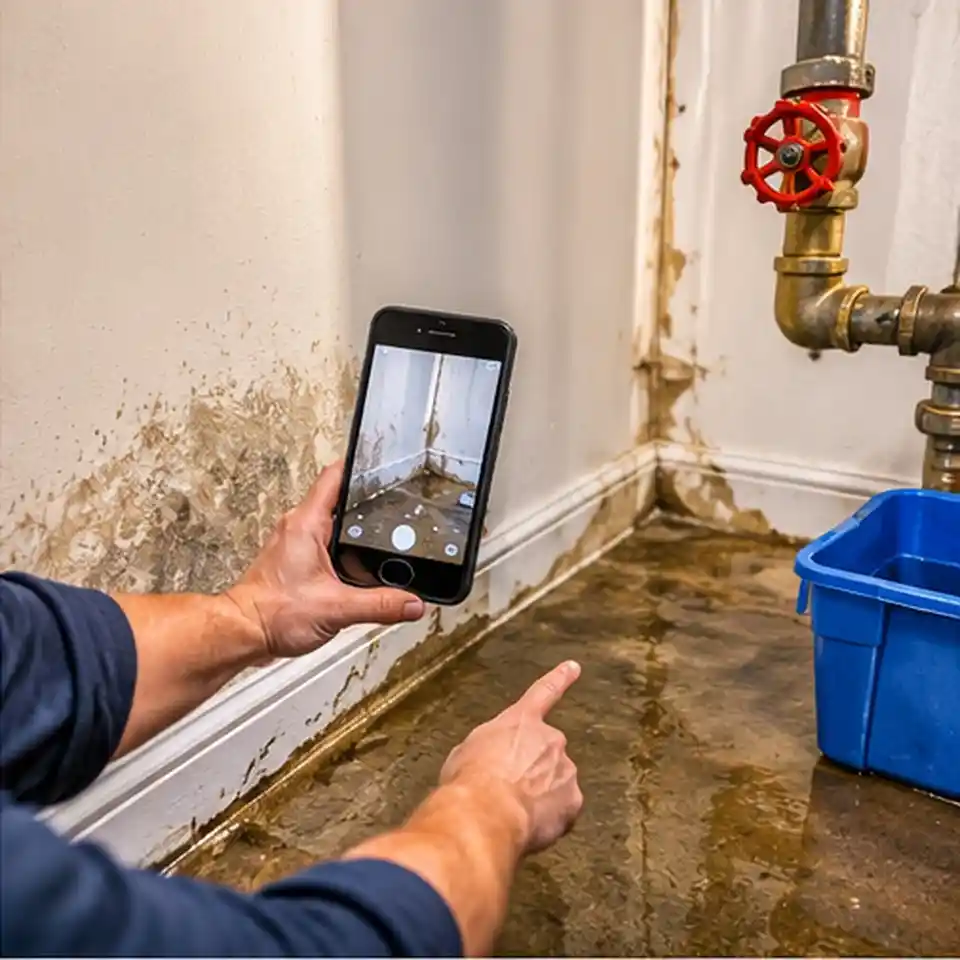
- Photograph and video everything. Capture water depth, damaged items, and the source before anything moves.
- Move valuables upstairs. Prioritize documents, electronics, and photos.
- Lift furniture off wet floors. Place aluminum foil or wood blocks under legs to stop staining and wicking.
- Close interior doors. This keeps humid air from migrating into dry rooms.
- Skip the household vacuum. Shop vacs and standard vacuums create shock hazards in standing water.
- Leave HVAC fans off. Running the system can spread spores and contaminated moisture through ductwork.
- Call a certified restoration team. Professional extraction removes up to 99% of standing water in hours.
Pro/Con: DIY vs. Professional Extraction
| Method | Pros | Cons |
|---|---|---|
| Shop vac / buckets | Free, immediate | Slow, removes surface water only, leaves pad saturated |
| Rented pump | Moves volume fast | No moisture mapping, misses hidden water |
| Truck-mounted extraction | Removes water from pad and subfloor, fast | Requires a professional crew |
| Weighted extraction tools | Pulls water from carpet and pad in place | Requires trained operator |
Most failed DIY jobs share one problem: hidden moisture left inside walls. For any flooded basement cleanup Brentwood Plaza job beyond a small puddle, schedule professional water extraction before the water changes category.
Our Flooded Basement Cleanup Process
Our process follows a set sequence: inspect, extract, dry, sanitize, restore. Each stage has measurable goals.
At Topeka Water Damage Restoration, we aim to arrive within 60 minutes of your call. We operate 24/7, including holidays and storm nights. That response time is the foundation of effective flooded basement cleanup Brentwood Plaza families rely on.
- Inspect and map moisture. We use pin and pinless meters plus thermal imaging to find wet areas behind walls.
- Classify the loss. We assign category and class to set PPE and drying targets.
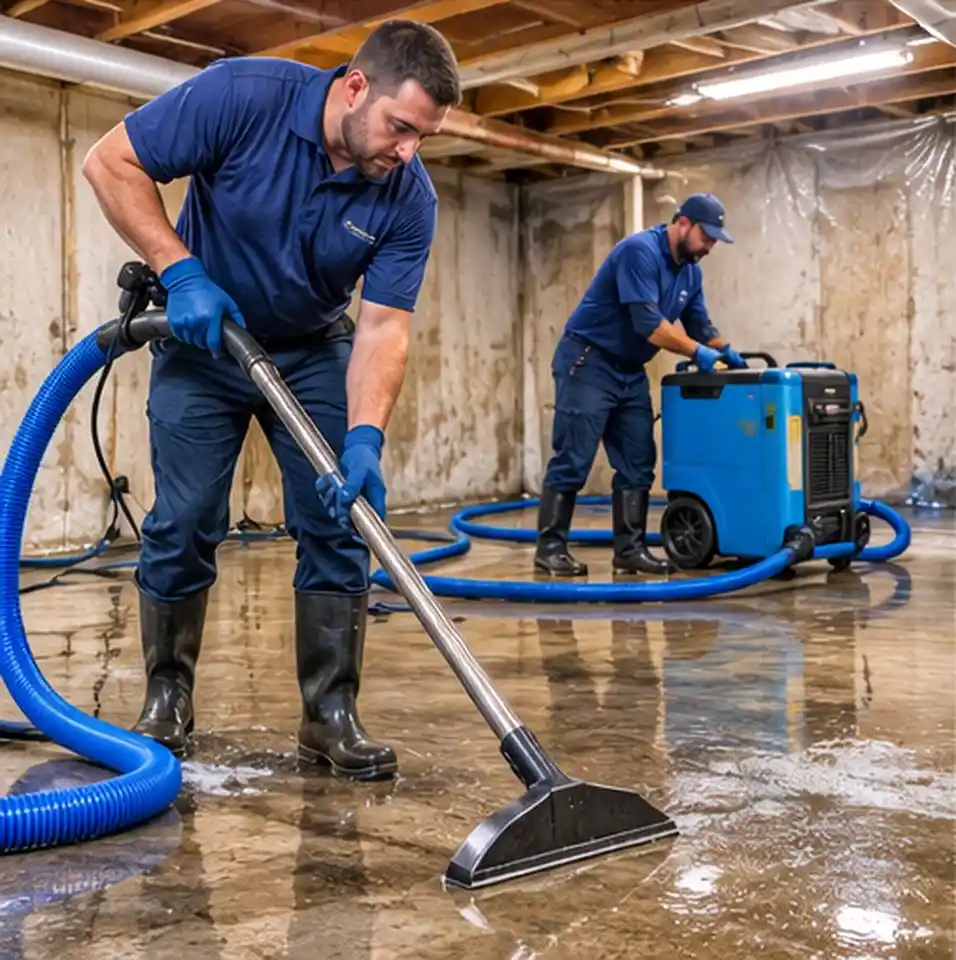
- Extract standing water. Truck-mounted and portable units pull water from floors, carpet, and pad.
- Remove unsalvageable materials. We cut wet drywall, pull saturated pad, and bag debris.
- Apply antimicrobial treatment. EPA-registered products go on all affected surfaces.
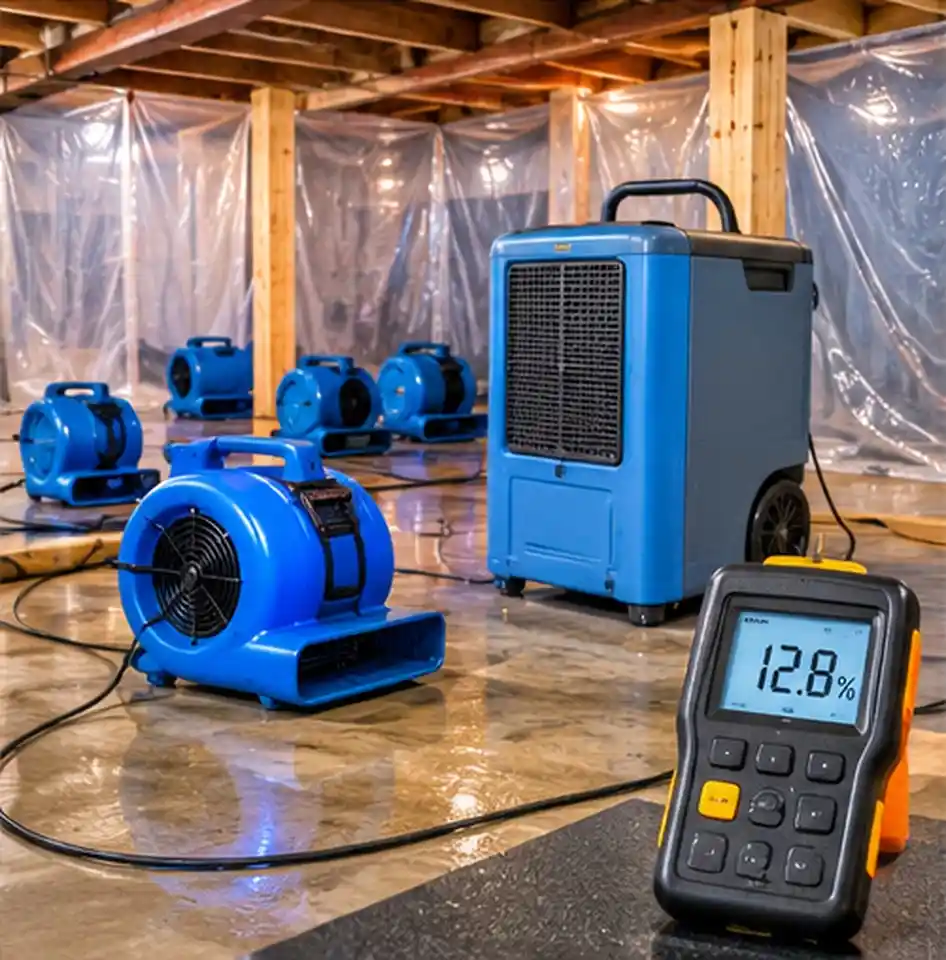
- Set up structural drying. Air movers and dehumidifiers run on a calculated layout.
- Monitor daily. We log readings and adjust equipment until materials hit dry standard.
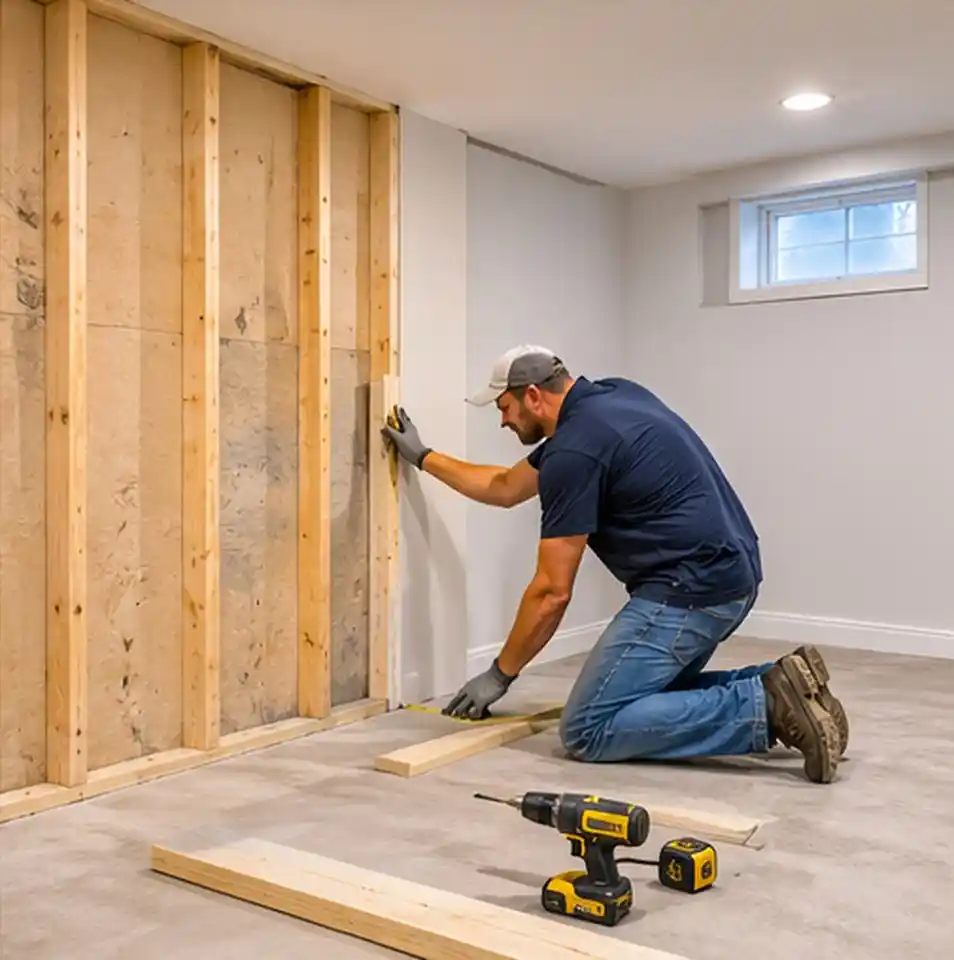
- Restore and rebuild. We replace drywall, flooring, and trim once everything tests dry.
Our Core Service Catalog
Our full lineup of residential water damage restoration Topeka KS services covers every basement scenario:
| Service | When You Need It |
|---|---|
| Water Extraction | Standing water on any floor surface |
| Water Removal | Large-volume flooding needing pumps and extractors |
| Flood Cleanup | Storm, creek, or groundwater intrusion |
| Basement Water Removal | Any below-grade water event |
| Sewage Cleanup | Drain or sewer backup, Category 3 water |
| Burst Pipe Water Damage | Frozen or failed supply lines |
| Structural Drying | Wet framing, subfloor, drywall, concrete |
| Mold Remediation | Visible growth, musty odors, post-flood prevention |
| Toilet Overflow Cleanup | Bathroom overflows dripping into the basement |
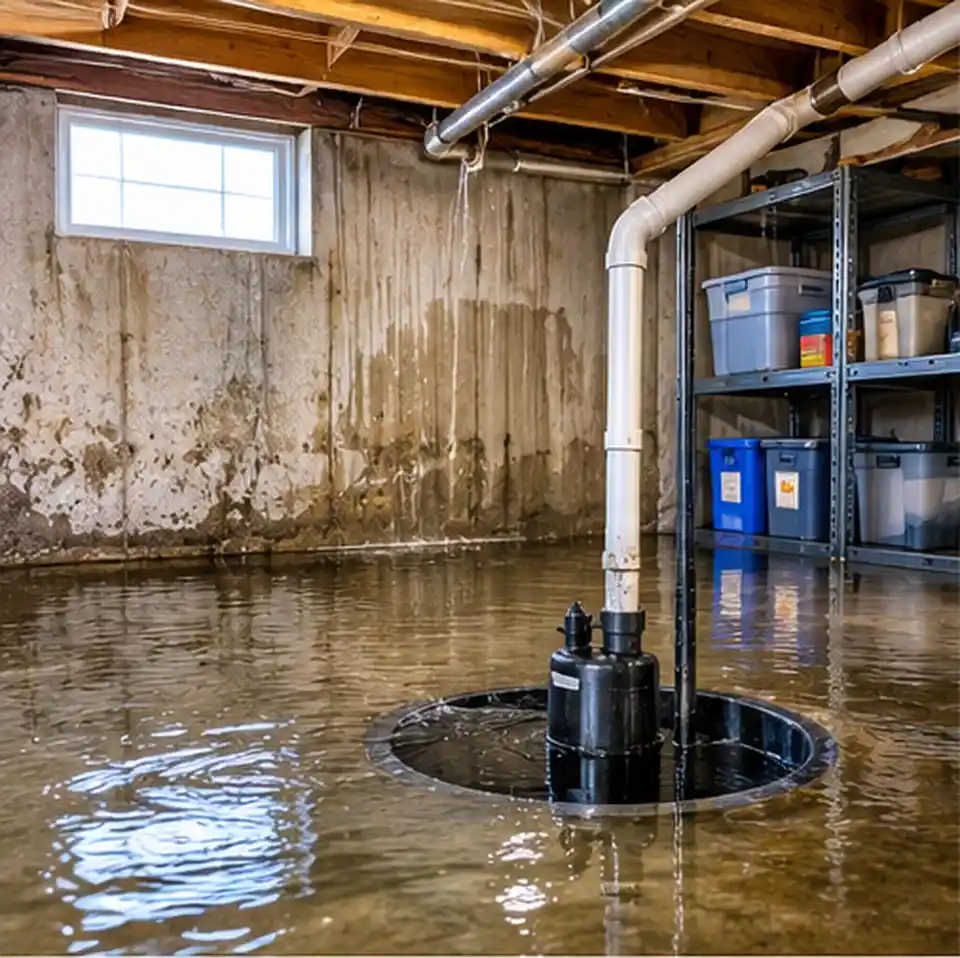
| Sump Pump Failure Cleanup | Pump burnout, power loss, or float switch failure |
Winter is our busiest season for burst pipe water damage. Insulate exposed basement pipes before the first hard freeze.
Structural Drying Timelines & Equipment Metrics
Structural drying removes moisture trapped inside building materials, not just surface water. This is where most of the work happens.
The IICRC water damage restoration standards set the framework for drying goals, equipment placement, and documentation. We follow the ANSI/IICRC S500 standard on every job. Dry means dry by meter reading, not dry to the touch.
| Metric | Target / Standard | Why It Matters |
|---|---|---|
| Typical drying time | 3 to 5 days (Class 1 to 3) | Longer drying raises mold risk |
| Class 4 drying time | 5 to 14+ days | Dense materials release water slowly |
| Air movers | 1 per 10 to 16 linear feet of wet wall | Moves saturated air off surfaces |
| Dehumidifiers (LGR) | Sized by cubic feet and class | Pulls moisture out of the air |
| Target relative humidity | Below 50% in drying zone | Stops evaporated water from re-absorbing |
| Wood framing moisture | Under 15% or within dry standard | Prevents rot and mold |
| Drywall moisture | Matches unaffected drywall reading | Confirms complete drying |
| Concrete slab | Matches dry reference area | Prevents flooring adhesive failure |
| Monitoring frequency | Every 24 hours | Tracks progress and justifies equipment days |
Equipment Setup by Basement Size
| Basement Size | Air Movers | Dehumidifiers | Est. Drying Days |
|---|---|---|---|
| Under 500 sq ft | 3 to 5 | 1 LGR | 2 to 3 |
| 500 to 1,000 sq ft | 6 to 10 | 1 to 2 LGR | 3 to 4 |
| 1,000 to 1,500 sq ft | 10 to 15 | 2 to 3 LGR | 3 to 5 |
| Finished, 1,500+ sq ft | 15+ | 3+ LGR plus wall cavity drying | 4 to 7 |
If you’ve lived through a humid Topeka summer, this moisture containment protocol makes complete sense. We seal the drying zone with poly sheeting so dehumidifiers fight only the basement air, not the whole house. A well-run flooded basement cleanup Brentwood Plaza job always includes this containment step.
Ask your contractor for the daily moisture log. Then review the structural drying plan before equipment comes out.
Mold Mitigation Checklist
Mold mitigation after a flood is moisture control first, cleaning second. Kill the moisture and you stop the growth.
The EPA mold guidelines state plainly that the key to mold control is moisture control. The EPA recommends drying wet materials within 24 to 48 hours to prevent growth. That window shapes every decision in flooded basement cleanup Brentwood Plaza properties need.
Before Drying Starts
- Remove wet porous items like cardboard boxes, paper, and fabric within 24 hours
- Cut drywall at least 12 inches above the visible wet line (24 inches for Category 3)
- Pull baseboards to expose the bottom plate and wall cavity
- Apply antimicrobial to framing, slab, and exposed cavities
- Set containment with poly sheeting and zipper doors
During Drying
- Hold humidity below 50% in the drying zone
- Check hidden areas behind paneling, under stairs, and inside built-ins
- Watch for musty odor: it signals growth before you see it
- Keep HVAC off in the affected zone if returns are in the basement
After Drying
- Verify readings match dry standard on all materials
- Inspect with thermal imaging for cold, damp spots
- HEPA vacuum all surfaces before rebuild
- Install a basement dehumidifier set to 45% to 50% for long-term control
- Schedule a follow-up check 30 days after rebuild
Our crews see summer mold outbreaks most often in Sherwood and Highland Park basements where sump pits sit uncovered. An uncovered sump pit acts like an indoor humidifier. If you smell mustiness or see spotting, book a mold remediation inspection this week.
How Water Damage Restoration Topeka KS Protects Your Home From Structural Mold Damage
Estimated Repair Costs in Topeka, KS
Basement flood costs depend on water category, square footage, and finish level. Category 3 water and finished basements drive costs up fastest.
The figures below reflect typical Topeka market ranges. Your actual cost comes from an on-site assessment. We provide transparent, line-item estimates before work begins, so there are no surprises on your flooded basement cleanup Brentwood Plaza invoice.
| Service | Estimated Cost Range | Key Cost Drivers |
|---|---|---|
| Water extraction (Cat 1) | $3 to $7 per sq ft | Depth, flooring type |
| Water extraction (Cat 3) | $7 to $12 per sq ft | PPE, disposal, sanitizing |
| Structural drying (per day) | $300 to $1,000+ | Equipment count, basement size |
| Drywall removal and replacement | $2.50 to $6 per sq ft | Height of cut, finish level |
| Carpet and pad replacement | $3 to $8 per sq ft | Carpet grade |
| Sewage cleanup | $2,500 to $10,000+ | Volume, affected area |
| Mold remediation | $1,500 to $6,000+ | Square footage, containment level |
| Sump pump replacement | $600 to $2,000 | Pump type, battery backup |
Total Project Estimates by Scenario
| Scenario | Typical Total Range |
|---|---|
| Small leak, unfinished basement | $1,000 to $3,000 |
| Burst pipe, partially finished | $3,000 to $8,000 |
| Sump failure, finished basement | $5,000 to $15,000 |
| Sewage backup, finished basement | $10,000 to $25,000+ |
| Creek or river flood, full basement | $15,000 to $40,000+ |
Delay is the biggest cost multiplier. A Category 1 job left for three days becomes a Category 3 mold job. Request a free on-site estimate for flood cleanup the same day water appears.
Materials Mitigation: Salvage vs. Replace Guidelines
Salvage decisions follow material porosity and water category. Dense materials survive; porous materials soaked in contaminated water do not.
We test every material with a meter before deciding. Saving what can be saved lowers your claim amount and speeds up rebuild. Replacing too much wastes money; saving too much invites mold.
| Material | Category 1 | Category 2 | Category 3 |
|---|---|---|---|
| Concrete slab | Salvage, dry | Salvage, clean, dry | Salvage, sanitize, dry |
| Drywall | Salvage if dried in 48 hrs | Cut and replace wet areas | Replace, 24+ in. above waterline |
| Fiberglass insulation | Replace if saturated | Replace | Replace |
| Carpet | Often salvage | Possibly salvage | Replace |
| Carpet pad | Usually replace | Replace | Replace |
| Solid hardwood | Salvage with specialty drying | Case by case | Usually replace |
| Laminate / engineered wood | Usually replace | Replace | Replace |
| Luxury vinyl plank | Lift, dry subfloor, reinstall | Lift, clean, often reinstall | Usually replace |
| Wood framing (studs) | Salvage, dry | Salvage, clean, dry | Salvage, sanitize, dry |
| Upholstered furniture | Possibly salvage | Professional cleaning | Discard |
| Paper documents / photos | Freeze, then restore | Freeze, then restore | Specialty restoration only |
Older Potwin and Westboro homes often have plaster walls. Plaster is dense and often dries in place, which saves both money and historic character. Ask your technician to show you the meter readings that justify each tear-out.
Insurance Claim Steps for Basement Floods
A successful basement flood claim depends on the cause of the water and your policy type. Standard homeowners policies and flood policies cover very different events.
Most homeowners insurance excludes flood damage. According to FEMA’s National Flood Insurance Program, flood coverage is a separate policy, and new NFIP policies carry a 30-day waiting period in most cases. NFIP coverage in basements is also limited, so check your declarations page before any flooded basement cleanup Brentwood Plaza project starts.
What Typically Covers What
| Water Source | Homeowners Policy | Flood Policy (NFIP) | Sewer Backup Endorsement |
|---|---|---|---|
| Sudden burst pipe | Usually covered | Not applicable | Not applicable |
| Slow leak over time | Usually excluded | Not covered | Not covered |
| Surface flooding / creek overflow | Excluded | Covered (basement limits apply) | Not covered |
| Sewer or drain backup | Excluded without rider | Covered only if caused by flood | Covered |
| Sump pump failure | Excluded without rider | Covered only if caused by flood | Covered |
Step-by-Step Claim Process
- Stop the source safely. Insurers expect you to prevent further damage.
- Document before cleanup. Take wide shots, close-ups, and video of every wet item.
- Call your insurer within 24 hours. Get a claim number and adjuster contact.
- Hire a restoration company immediately. You do not need to wait for the adjuster to start mitigation.
- Keep damaged items until the adjuster sees them, or photograph them with measurements.
- Request moisture logs and drying reports. These prove the work was necessary.
- Save every receipt. Include hotel stays, meals, and equipment rentals.
- Review the adjuster’s estimate line by line. Compare it to your contractor’s estimate.
- Ask about mold coverage limits. Many policies cap mold remediation.
- File for supplements if hidden damage appears during demolition.
We work directly with insurance adjusters and provide photo documentation, moisture maps, and drying logs. Call your agent today and ask one question: do I have a sewer backup endorsement? If not, adding one before the next storm is worth the small premium. Our water removal reports are built to support your claim from day one.
How to Choose the Best Water Damage Restoration in Topeka, KS
The best water damage restoration Topeka KS homeowners can hire combines certification, response speed, and transparent pricing. Credentials matter more than ads.
Searching “water damage restoration near me Topeka KS” returns dozens of results. Some are national call centers that subcontract to whoever is available. Use this checklist to filter them:
| What to Check | What Good Looks Like | Red Flag |
|---|---|---|
| Certification | IICRC-certified technicians (WRT, ASD, AMRT) | No certification listed |
| Response time | On site within 60 to 90 minutes | “We’ll get to you tomorrow” |
| Local presence | Physical Topeka address | Out-of-state call center |
| Pricing | Written, itemized estimate | Verbal quote only |
| Documentation | Daily moisture logs and photos | No readings provided |
| Insurance | Works directly with adjusters | Demands full payment upfront |
Reading Water Damage Restoration Topeka KS Reviews
Water damage restoration Topeka KS reviews reveal patterns that marketing copy hides. Look for these signals:
- Mentions of arrival time after a late-night call
- Comments on communication during the drying phase
- Insurance experience and whether claims went smoothly
- Specific neighborhoods that confirm a local crew
- How the company handled a complaint or setback
Read the three-star reviews first. They tell you how a company performs when something goes wrong. Then call the company and ask what certifications the technician coming to your home holds.
Frequently Asked Questions
How fast should a flooded basement be cleaned up?
Extraction should begin within 24 hours. Structural drying should start within 48 hours to prevent mold growth. Clean water also degrades into contaminated water after 24 to 48 hours.
Can I clean a flooded basement myself?
You can handle small Category 1 leaks on bare concrete. Anything involving sewage, floodwater, finished walls, or more than a few inches of water needs professional equipment. Hidden moisture inside walls is the most common DIY failure.
How long does basement drying take?
Most basements dry in 3 to 5 days. Class 4 losses with hardwood, plaster, or saturated concrete can take one to two weeks. Daily moisture readings determine when drying is complete.
Does homeowners insurance cover a flooded basement?
It depends on the water source. Sudden pipe bursts are usually covered. Surface flooding requires a separate flood policy, and sewer or sump backups require a specific endorsement.
Is it safe to stay in my house during basement drying?
Yes, for Category 1 and 2 losses with proper containment. For Category 3 sewage losses, we recommend keeping children, pets, and anyone with respiratory issues away from the affected level until sanitizing is complete.
What does a sump pump failure cleanup involve?
We extract water, inspect the pump and float switch, and dry the affected area. Sump pump water is treated as Category 2 or 3 depending on the source. We also recommend a battery backup pump to prevent repeat failures.
Do you serve areas outside Topeka city limits?
Yes. We serve Tecumseh, Auburn, and Berryton along with every Topeka neighborhood, including Westboro, College Hill, Potwin, NOTO Arts District, Highland Park, and Sherwood.
What should I do if a toilet overflow leaks into my basement?
Shut off the toilet supply valve behind the bowl. Turn off power to any basement lights below the leak. Call for toilet overflow cleanup, because ceiling drywall and insulation can hold contaminated water out of sight.
Get Help Now: 24/7 Flooded Basement Cleanup in Topeka
Fast response is the single biggest factor in reducing basement flood damage. Our crews are on call 24 hours a day, 7 days a week.
At Topeka Water Damage Restoration, we deliver flooded basement cleanup Brentwood Plaza homeowners and every surrounding neighborhood can trust. We provide IICRC-based drying protocols, transparent written estimates, and direct insurance coordination. Our technicians explain each step in plain language, with no hidden charges.
| Contact | Details |
|---|---|
| Emergency Phone | (877) 679-6340 |
| Address | 5720 SW 21st St, Topeka, KS 66604 |
| Hours | 24/7, including weekends and holidays |
| Response Goal | On site within 60 minutes |
| Service Area | Topeka, Tecumseh, Auburn, Berryton |
From water extraction to sump pump failure cleanup, see our complete water damage restoration services in Topeka and call (877) 679-6340 now to get a crew on the way.